Sunday, December 17, 2006

Iran Pushing Lebanon into Civil War

From the Globe & Mail:

Founder lashes out at Hezbollah
by Mark MacKinnon

BAALBEK, LEBANON — Hezbollah has lost sight of its original principles, according to the founder of the militant Shia group, and it is pushing Lebanon toward civil war to serve the interests of its masters in Tehran.

In a rare interview at his guarded compound in Lebanon's Bekaa Valley, Sheik Sobhi Tufeili criticized Hezbollah and the movement's current leader, Sheik Hassan Nasrallah, for putting Iranian interests ahead of Lebanese ones in the country's flammable political standoff.

"The relationship of Hezbollah with Iran is [one of] complete, loyal submission," the bespectacled sheik said, a grey beard jutting out from his chin.

He said that while Shia groups in Afghanistan, Iraq and Lebanon look to Tehran with deference, Iran sees Shiites outside its borders as expendable pawns to be used "if they need 1,000 Shiites to be killed here, or 1,000 Shiites to be killed there."

... In the current Lebanese political crisis, hundreds of thousands of protesters have answered Mr. Nasrallah's call to surround government offices in the centre of Beirut, demanding the resignation of Prime Minister Fouad Siniora and his pro-Western cabinet.

Neither side has shown any sign of giving in. Last night, Mr. Nasrallah called for demonstrators to remain in the streets for as long as it takes to topple the government. Tensions are high, particularly between Shia supporters of Hezbollah and Sunni Muslims who fiercely back the government. Mr. Siniora is a Sunni.

While Hezbollah says it is protesting against a government that is unrepresentative of most Lebanese and a puppet of the United States, Mr. Tufeili said such claims are really a smokescreen for the real goal: expanding Iran's influence in Lebanon and the region. He compared groups such as Hezbollah and the Iranian-backed Supreme Council for Islamic Revolution in Iraq to the organizations the Soviet Union once used to spread its influence abroad.

"They [Iran] use the Shiites all over the world for their purposes, just as the USSR used to do with communist parties all over the world. Today, Iran sacrifices these Islamic parties for their benefit."

Mr. Tufeili said Hezbollah's protests in Beirut are leading the country toward a conflict from which only outside forces will gain. While Iran and Syria are backing the Hezbollah-led opposition, the United States, France and some Sunni Arab states have lent support to the government.

... Mr. Tufeili's condemnation of Hezbollah was fierce and wide ranging. He said the party should give up its arms for the sake of civil peace and -- remarkably for someone who once opposed any ceasefire -- questioned the leadership's logic in provoking this summer's war with Israel.

The reason Lebanon's current crisis is so dangerous is that most Lebanese are more loyal to their sects than to their country, Mr. Tufeili said. He said that needs to change and that Lebanon's Shiites in particular must break the tradition of blindly following their leader.

For that to happen, he said, Iran needs to stop buying the community's loyalty with money. He said that when he was Hezbollah secretary-general, Iran was the movement's partner. Now, he said, it has long since become the master.

"I beg [Iran] to leave us," he said. "Don't take us into civil war. If you can't leave us, don't harm us. We're fed up with wars and destruction."

Related Posts
The Israelis and Lebanese Need Our Help
Perspectives
Threat and Opportunity

Turner on Harper

Garth Turner, Independent Conservative MP, on Stephen Harper:

Mr. Harper represents a doctrinaire Reform Party point of view that can be seen in his courting of the religious right, in dismantling gun control legislation, in voting to overturn same-sex marriage, in his bungling of the environment file and his arrogant flip-flop on the taxation of income trusts. In addition, his hasty initiative in having the Quebecois declared a nation within Canada is one of the most potentially destructive moves imaginable for a federal leader at this time. In addition, Mr. Harper has consistently ignored the views of his caucus – MPs and ministers alike – encouraging no debate of key policy initiatives, announcing major changes completely without discussion, and thereby disenfranchising millions of voters like you.

In short, I believe Mr. Harper is quite possibly the worst threat to the Conservative movement. He does not embody any of the socially progressive elements of Conservativism which voters in our region desire. In fact, my months of door-knocking in the last election convinced me I was elected in spite of Stephen Harper, not because of him. Worse, he has turned his back on those things that Reform should be lauded for – a deep respect for the voters witnessed by empowerment of MPs, referenda and other direct democracy initiatives.

Unfortunately I sense Mr. Harper’s narrow brand of Conservativism has little or no growth potential among Canadians, as it does not represent the mainstream.


###

Churn

In the newspaper business, the word "churn" refers to the turnover in subscribers. Since there is a cost associated with attracting subscribers, low churn is an indicator of efficiency.

On This Week With George Stephanopoulos today, George Will provided a startling statistic: In the US every year, one-thirteenth of all jobs are lost. More jobs are created, but there is growing churn in the workforce, largely caused by globalization. This trend is not going away. If anything, employment churn will increase.

Other than during recessions, high employment churn is a new thing. We probably can't do anything to improve the degree of churn, but we need to adjust to it to help displaced workers. We need improved employee protection around the area of lay-offs and severance pay. We need better institutions to help people retrain and find work. We need UI payments to kick in sooner.

Our current systems were created not only for a time of lower employment churn, but also for a time of greater unionization. In today's world, most people do not have a union ready to fight for them. We need strong employment regulations that protect everybody. As in places like France, we need the state to step up and provide protection. But this isn't going to happen unless we demand it.

Unfortunately, elected officials all have extremely generous pension plans and the civil servants who provide much of the legislative initiative are already protected by the most powerful union contracts in the country. Stronger employment protection isn't going to happen unless the people rise up and make it an election issue, and even then it won't happen quickly.

If we don't act soon, many Canadians are going to find themselves in deep distressing poverty when they retire. When young people think their investment strategy is adequately preparing them for retirement, are they considering that they will almost certainly be laid off at some time during their career... and most probably will have to start again at a lower paying job? And that they may need to dip into their retirement savings during the period that they're unemployed? That stock market/housing market collapses could wipe out their personal retirement savings?

We do not have adequate employment protections for the current world.

Related Posts
In Praise of Regulations
Employee Protection

###

Saturday, December 16, 2006

What Is the Liberal Party Doing to Address Race-Based Hatred Within the Party?

The following two articles, which I reproduce in their entirety, paint a very bleak picture of racial hatred in the Liberal party. Stephane Dion has condemned the incidents, but what is he doing about it? There is no reason to think it won't happen again. There is no reason to think that any of us won't be the targets next time: women, gay people, Jews, Muslims, other vulnerable minorities. There isn't enough outrage. There isn't enough discourse about this. We need an internal inquiry and a plan to make sure this never, ever happens again. It's not about Muslims hating Jews. It's about voting blocks and lack of ethics in gaining their support. It's about a system that allowed hate to flourish. It's about lack of leadership on what is appropriate participation in the political process. It's an enormous scandal, and needs to be treated as such.

Bob Rae target of anti-Semitism in recent Liberal leadership contest Joan Bryden, Canadian Press
Published: Friday, December 08, 2006
Joan Bryden, Canadian Press

OTTAWA (CP) - Bob Rae was the target of anti-Semitic attacks during the Liberal leadership contest, motivated at least in part by the fact that his wife is Jewish.

Sources close to Rae say that his wife, Arlene Perly Rae, was approached during last weekend's convention by a delegate who didn't realize she was the candidate's wife. The delegate told her not to vote for Rae "because his wife is Jewish."

Perly Rae stonily informed the delegate that she was the wife in question. The delegate beat a hasty retreat.

The incident might have been shrugged off if it had been an isolated event. But Rae team insiders contend it was part of a larger pattern of anti-Semitic smears on Rae, who finished third.

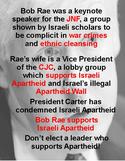
A flyer was circulated electronically among convention delegates denouncing Rae for having once delivered a speech to the Jewish National Fund, a group the flyer said was complicit in "war crimes and ethnic cleansing."

"Rae's wife is a vice-president of the CJC (Canadian Jewish Congress), a lobby group which supports Israeli apartheid," said the flyer in bold letters superimposed over a close-up of Rae's face.

"Bob Rae supports Israeli apartheid. Don't elect a leader who supports apartheid."

The Canadian Jewish Congress has condemned the flyer and blamed Khaled Mouammar, president of the Canadian Arab Federation for circulating it. The federation has, in turn, accused the CJC of making "a pitiful attempt to discredit" it and has denied producing or distributing the flyer.

Nevertheless, in a release Thursday, the federation supported the content of the flyer.

"CAF believes that Canadians have the right to know the factual information provided" in the flyer, the federation said.

It went on to say that the Jewish National Fund manages all state lands in Israel and allows only Jews to live on such land, a "practice that amounts to ethnic cleansing," and added that "Canadians have the right to know who supports the JNF in Canada."

The flyer was produced and e-mailed to all MPs by Ron Saba, editor of an obscure magazine called Montreal Planet. But The Canadian Press has obtained an e-mail from Mouammar, in which he forwarded the flyer to others. Several days before Saturday's leadership vote, it wound up being posted on a website operated by an immigrant advocacy group.

Mouammar wrote on that website that the flyer had "nothing to do with Bob Rae's and his wife's religion and ethnicity but has a lot to do with their political views."

"It is well-known that Bob Rae himself is hostile to Palestinians and Arabs," Mouammar wrote.

He added that "his wife's leadership position in the Canadian Jewish Congress (CJC) should be a matter of concern to everyone" and went on to condemn the CJC as "an ardent supporter of Israel, lam basts (sic) anyone who dares to criticize Israel and resorts to undermining human rights and civil liberties to protect Israel's war crimes."

Ed Morgan, president of the Canadian Jewish Congress, called on the Liberal party Thursday to denounce the flyer.

While it's legitimate to criticize a candidate's position on the Middle East, Morgan said there can be only one purpose in raising the fact that Rae's wife is a member of the Congress's board: "It's strictly to say that his wife is a Jew."

But the flyer wasn't the only example of anti-Semitic attacks on Rae.

On another website, operated by a Montreal-based pro-Palestinian group, Liberals were urged about a week before the leadership vote: "Do not vote for Bob Rae, we're not looking or another Zionist PM."

The group recommended that delegates vote for Gerard Kennedy, the fourth-place contender whose dramatic decision to throw his support to Stephane Dion after the second ballot clinched the victory for Dion. It said that "voting for Bob Rae is a vote for the daily massacre in Palestine (and) . . . for a new Zionist PM in Canada."

Rae could not be reached for comment Thursday but insiders say he was aghast and hurt by the attacks.

The smears have raised broader questions about the role that blocs of ethnic delegates played at the convention in securing a stunning, come-from-behind victory for Dion.

On the opening day of the leadership convention, the Muslim Canadian Congress blasted "self-styled leaders from the Muslim community" for suggesting they could direct Muslim delegates to vote en masse for the candidate of their choice.

"Muslim delegates at the convention are not a herd of cattle for sale to the highest bidder," Muslim Canadian Congress vice-president Salma Siddiqui said in a release.

Siddiqui, a supporter of frontrunner Michael Ignatieff, accused Mohamed Elmasry, head of the Canadian Islamic Congress, of trying to bargain with leadership candidates on behalf of some 200 to 300 Muslim delegates.

Heading into the convention, the CIC had interviewed the top contenders and ranked Dion and Kennedy as the "most desirable potential winners," based on their track records and stands on "vital national and international issues." Rae was next while Ignatieff ranked as the least desirable of the top four.

Elmasry said Thursday that Siddiqui's charges were "nonsense" and "an insult" to Muslim delegates, implying that they had "no brain of their own."

He said the CIC held a breakfast meeting with the top four candidates last Saturday morning, just before voting on the second ballot began, to give them all an equal chance to impress Muslim delegates. He said the council was trying to engage and educate Muslim delegates, not herd them.

Elmasry added that he assured Rae that his wife's religion "is not an issue for us."

But Tarek Fatah, a Rae supporter and member of the Muslim Canadian Congress, said appeals to "tribalism" went well beyond the Muslim delegates. He said Kennedy, despite his claim to represent party renewal, was the candidate who benefited most from the support of Muslim, Sikh, Ukrainian and Tamil blocs, who moved en masse to Dion after the second ballot.

"This is a step back," Fatah said in an interview, adding that Kennedy has "taken us back to the '30s and '40s" when Catholics and Protestants voted in blocs.

"It's tainting the political system where policies aren't being discussed but race, ethnicity and religion (are pivotal)."

Toronto MP Navdeep Bains, who is credited with moving 237 Sikh delegates from Kennedy to Dion, said Fatah's complaints are simply "sour grapes."

"Like anyone else, as a member of Parliament and as a member of the community, you try to exert as much influence as you possibly can," he said in an interview.

"That's what it really boils down to, the ability to exert influence and try to convince people about the right decision. But ultimately, the delegates made up their own minds."

Bains said the group of delegates he influenced were not only Sikhs but from a variety of ethnic backgrounds.

Kennedy could not be reached for comment.

Race and religion at the Liberal Party convention

By TAREK FATAH
The Globe and Mail

Rev. Francis Xavier is the father figure of Toronto's vibrant Tamil community. His question to Bob Rae at a meeting with Canadian Tamils a few days before the Liberal Party convention was typical of the role played by the leaders of some minority racial and religious groups in blatant efforts to wield political muscle.

The diminutive Father Xavier did not mince his words in laying out the price for the support of the 45 Tamil Canadian delegates to the Liberal convention: "Mr. Rae, I am great fan of yours and you have done a lot for the Tamil community as premier of Ontario, but will you promise to delist the Tamil Tigers from Canada's list of terrorist organizations, if you become leader of the Liberal Party and prime minister of Canada?"

Mr. Rae replied that if Tamil Canadians wanted the Tigers to be delisted, they should pressure the LTTE to do what Yasser Arafat did with the PLO and Nelson Mandela did with the ANC. "Firstly, there can be no military solution to the war in Sri Lanka and, second, if any politician promises you that he will help delist the LTTE as a terrorist organization, he is not telling the truth," he said. His response did not go down well -- and nary a Bob Rae button was to be found on the 45 Tamil Canadian delegates at the convention.

In the months leading up to the Montreal convention, several groups such as this could be found bargaining the price of their cadre of delegates. Besides supporters of the Tamil Tigers, the groups included Kurdish backers of the imprisoned Abdullah Ocalan, remnants of the pro-Khalistan Sikhs, and Islamist Muslims.

Perhaps the most influential of these groups would turn out to be the Khalistani Sikh Canadians, many from areas west of Toronto, who voted en masse for Gerard Kennedy in the convention's first and second ballots.

Bob Rae had advised the Liberal government on the public interest in an inquiry into the 1985 Air-India bombing. It would come back to haunt him. The bombing featured in some of the exchanges when Mr. Rae addressed a South Asian event in Montreal on Friday.

When Mr. Rae slammed the terrorists responsible for Canada's worst act of terrorism, he found little support in the room. "He is referring to all Sikhs as terrorists," one delegate said to a B.C. senator campaigning for Mr. Rae. "Not true," the Senator said, but the delegate simply walked away.

Another religious group, the Canadian Islamic Congress, organized by Mohamed Elmasry, sent out a mass e-mail to its members with the subject line: "More Canadian Muslims than ever before will help determine Liberal Leadership Outcome."

A religiously observant breakfast was arranged for Muslim delegates to the convention, and one Kennedy delegate organizing among the Muslim community sent out a letter to the country's mosques, asking for Muslims to vote "en masse" for one candidate. The Islamic Congress had given Mr. Kennedy an A grade, while listing other hopefuls on a scale from a B to an F.

This led to a spirited response from Ignatieff delegate Salma Siddiqui, who is a vice-president of the secular Muslim Canadian Congress. "Muslims are not a herd of cattle to be sold to the highest bidder," she responded.

Then, during the convention, the president of the Canadian Arab Federation, Khaled Mouammar forwarded a mass e-mail to Muslim delegates. The e-mail, with the subject line, "Don't elect a Leader who supports Apartheid," had a picture of Bob Rae with the following text plastered over his face:
"Rae's wife is a Vice President of the CJC, a lobby group which supports Israeli apartheid and Israel's illegal Apartheid Wall. . . . Bob Rae supports Israeli Apartheid. Don't elect a leader who supports Apartheid."

It became a popular refrain. On Friday, a group of delegates coming from a breakfast arranged by the Canadian Islamic Congress taunted me: "Is Bob Rae going to be the prime minister of Israel or the prime minister of Canada?"

Two rookie MPs, Omar Alghabra, a Muslim, and, Navdeep Bains, a Sikh, held the strings of as many as 400 delegates in the Kennedy camp. When the time came, these delegates moved as a bloc to Mr. Dion.

Stéphane Dion may not know this, but his victory came in part through a political process that feeds on racial and religious exploitation. I respect the diversity of Canada, but I want to celebrate what unites us, not what divides us into tiny tribes that can be manipulated by leaders who sell us to the highest bidder.


Related Posts
Why the Liberal Leadership Campaign Sucked, Part 4

###

Love of Radio

I love talk radio, and thought I'd share some of my favorite sites in the hopes that my readers could offer up some more.

CBC Radio One
NPR
Minnesota Public Radio
BBC World Service
American Public Media

I'm not much for music radio, with one exception:
Hober

###

The Refreshing Renewal of Leadership Style

I was reading yesterday's Globe & Mail this morning while listening to CBC Radio, and happened to turn to a photo of Stephane Dion crossing the street on foot, by himself, carrying a heavy knapsack, looking at the ground in frowning concentration. At that moment the man himself came on the radio, responding to the questions of the day with his typical thoughtful, humble style, and it struck me what a revolution in leadership style this man has brought to our party.

The Liberal Party has frequently been called arrogant and without principles. Stephane Dion presents a totally opposite face. I'm under no illusions here - the man is a politician and, as the leadership race showed, is able to outsmart the smartest and crush his opponents. But he's so nice.

I love this unexpected change of attitude at that top. I hope the rest of the party can pick up a little of the Dion style. I hope he can maintain his true nature during the next election (and almost assured attacks on it by the opposition).

Blevkog recently posted the famous Trudeau Just Watch Me clip, and started a little discussion about Trudeau's ability to interact intelligently with reporters - as opposed to most of today's politicians, who tend to spout spin. Dion is very different from Trudeau, but he's as distinct from other politicians.

###

Friday, December 15, 2006

Turn Off Computer Equipment Over the Holidays

This is just a reminder that we shouldn't waste energy over the holidays by leaving on PCs, monitors or other equipment. Even in stand-by mode these devices suck up power.

For example, "David Smith, marketing director at Canon UK, said that businesses that don't turn off their PCs and printers are literally throwing money away as well as damaging the environment over the festive period."

This Wired blog on the topic got some great responses. My favorite is the guy who writes, "my RFID badge tells the system as I drive in the carpark and starts my computer up... by the time I have got to my office all the updates are installed."

###

Those Pesky So-Called Greenhouse Gas Emissions

We've all heard the statistics about Canada's terrible environmental record, and especially the increase in our greenhouse gas emissions since Canada signed the Kyoto Accord in 1993. The increase in Canada's greenhouse gas emissions is largely due to pollution in the Alberta oil patch.

There are existing technologies such as carbon sinks that could be used to reduce tar sand pollution. Jim Dinning, the frontrunner slash loser in the recent Alberta Conservative leadership race, was set to implement them. With his loss, the chance that Alberta will initiate significant environmental improvements on its own has declined.

It's time for the federal government to step in, and as Liberal leader Stephane Dion pointed out this week, we have a tool - government oil subsidies.

The Accelerated Capital Cost program, created 10 years ago to help a fledgling Alberta oil industry, is now giving an estimated $1.4 billion per year in tax breaks to an established, profitable - and environmentally disastrous - industry. Dion has suggested that the program be changed so that tax breaks are tied to environmental improvements. It's a wonderful idea.

Stephen Harper shot down the idea, saying central Canadians should stop picking on Alberta. But it is Harper who is standing alone on this issue, not Dion. According to the CBC, "former [Alberta] premiers Peter Lougheed and Ralph Klein, as well as Reform party founder Preston Manning, have all called for a move toward green technology. Lougheed has called it a "major wrong" that, under the current rules, Alberta taxpayers subsidize multiyear capital projects for an industry so lucrative that it has sent the cost of living skyrocketing in the province."

The second biggest cause of greenhouse gas emissions is manufacturing, which is centered largely in Ontario. But Canadian manufacturers have done a lot to improve their environmental record, and are much less polluting than they were ten years ago. As technologies became available their adoption was not altruism - environmentally sensitive manufacturing is also cheaper. The reason for the increase in pollution in this sector is because the low Canadian dollar greatly increased the output of manufacturing since 1993.

At a press conference today, Harper made what may be a slip of the tongue, and used the phrase "so-called greenhouse gases." It may be that Harper's dismissal of Dion's suggestion has little to do with his love of Alberta and a lot to do with his stubborn state of denial over the environment.

More Reading
Earth Day
Sierra Legal Defence Fund
Video of Harper saying "so-called greenhouse gases"

###

Sunday, December 10, 2006

Strategic Voting

I was reading an article on Proportional Representation that a commenter on an earlier post suggested I should read, and was taken aback by the author's main argument for abandoning our current system, which is that it leads to strategic voting - which the author describes as "anathema to democracy."

Anathema to democracy. Hunh.

I was an NDPer for my whole life until I switched to the Liberals. I made the complete move over to the Liberals just this year, but the transition was many years in the making (and I was active in the last provincial Liberal campaign). During my transition period, and even before, I was a strategic voter.

What did this mean? In my case, it meant I supported a party I didn't particularly want to get into power. I supported the NDP because of the alternative voice the NDP brings to debates. (For details, see Why I Left the NDP.) I still support the NDP in that regard, even though I am currently a committed Liberal member. The NDP has a lot to offer the country and we would be greatly diminished without its presence in parliament. In particular, the NDP has had a positive influence on the Liberal government and has pushed them to places they might not have gone otherwise - does anyone remember Jack Layton's deal with Paul Martin's minority government in 2005? I'm going on about this because the Liberals and NDP are natural allies, and there is always going to be a large, responsible area of cross-over among supporters of each.

So then why, as an active NDPer, did I consider voting Liberal in many elections? Of course the main reason was that I weighed my support for the NDP against my dislike of whoever was currently the Tory leadership. But strategic voted started for me with the 1979 election, when I voted for my preference (NDP) and then was not happy when Trudeau was defeated. So in the 1980 election, despite preferring the NDP leadership and my local NDP candidate, I voted Liberal. I have never regretted it.

But in some elections I was genuinely torn. Frequently the NDP candidate in my riding (and I have lived all over Ontario) was not of the highest calibre. In that case I generally voted NDP to help the party attract better candidates in future. But if I liked the Liberal candidate and it was a close race between the Liberal and Conservative, it could be difficult to support an NDP candidate I didn't respect, even though I wanted the NDP to do well nationally.

During my transition to a Liberal I also practised strategic voting. If my Liberal candidate looked dead-set to win, I'd consider voting for an NDP candidate, even if I wasn't thrilled with the person, just to make it possible for the NDP to attract better candidates in future.

I know that strategic voting is controversial because my friends in the NDP used to rail at me about it. But it seems perfectly democratic to me. No matter what system of voting we use, in the upcoming federal election I would find a way to vote that was most harmful to the chances of the Harper government. If the Tories move back to their (pre-hostile takeover) roots and elect a leader (and MPs) who are less stridently right-wing, then Canadians might not feel the need to be so strategic.

###

Let the Man Keep His Heritage Already

Dion should not be forced to renounce his French citizenship. Anyone who thinks he should should take a long, hard look at their attitudes towards the French - because nobody raised a peep about John Turner having dual citizenship with Britain, and John Turner was born there.

An aspect of this Tory-fabricated controversy that isn't getting mentioned enough is "What is citizenship?" In this case, Dion simply has a parent (mother) who was born in France. This means he has the ability to apply for a French passport and live in France. He does not have a French passport (I believe). He has never voted in France or paid taxes, as far as I know. He was not obligated to serve in the army there. He is a Canadian who has French heritage. ...Not that it would change the matter if he did have those connections, but I believe he doesn't.

I know something about dual heritage because I am a dual citizen of the United States. I haven't lived there since I was 7 years old, and I gave up my US citizenship when I became a Canadian at the age of 18. Renouncing my US citizenship was harder than I had realized it would be. I felt cut off from my roots. When the US changed the laws and allowed dual citizenship I applied for a US passport and felt enormously better. I cherish my US citizenship, not because it gets me anything or because I'd ever live in the US, but because it ties me to my ancestors in the US south and in Chicago; it means I am sure I can't be stopped at the border from visiting my relatives or going to a funeral; and because it's my heritage.

Demanding that someone renounce their citizenship is a huge deal. Asking Dion to renounce his French heritage is asking too much. For everyone who thinks this is an issue, I ask them to rethink it. Your slight unhappiness with his dual citizenship is nothing compared with his sense of connectedness to his mother and her native land.

Hey... Maybe Conrad Black is behind this... ;-)

###

Tricky Dick Rides Again

(It dawned on me that I couldn't criticize Liberals, as I may have been seen to be doing recently, without adding the Tory participation to the picture.)

During the Watergate investigation a lot of shady political maneuvers were discovered that were referred to as "dirty tricks". Nixon's campaign team messed with the Democrats any way they could think of: cancelling bookings for halls where rallies were supposed to be held, sending dozens of (unpaid) pizzas to Democrat headquarters, calling printers and changing Democrat campaign signs to have embarrassing typos, and on and on. (That was in addition to the bigger crimes like break-ins.)

It turns out that the Harper Tories have a bit of Tricky Dick in them. And they seem to be proud of it. CTV reports that immediately after the election of Stephane Dion, Tories on the convention floor started boasting that they had defeated Bob Rae. The Tories claimed that they had been handing out buttons saying "Go for Bob/Go for Broke," "Make Bob the first NDP prime minister," and "Vote Bob. Who needs Ontario?" - and that hundreds of delegates were wearing the Tory buttons while they voted. They also claimed that they had fabricated an internal party memo suggesting they were most afraid of facing Ignatieff as leader, but not afraid of a Rae win.

Jamie Elmhirst, president of the Liberal Party of Canada (BC), addressed this issue in a memo to his members, in which he said (in part):

Am I the only one who finds it utterly mind-boggling that the governing party of Canada sent people into the Liberal Party convention to perform these kinds of dirty tricks? Is Karl Rove already on the Conservative Party of Canada pay-roll? I think this really says something about the character of the people running our current government and it isn't positive. I am particularly disappointed with James Moore, a young MP I have a lot of respect for. This kind of garbage is beneath him, or at least I thought it was.

Canadians were not impressed with the negative character of the last federal election campaign. They want politicians of all stripes to set the bar higher. Our new Leader, Stephane Dion, is a man of ideas, vision and integrity. I'm confident that when we next face the electorate, it will be with a strong platform and positive message. Obviously our friends in the Conservative Party have not yet learned the same lesson.


###

Saturday, December 09, 2006

A Beacon for Human Rights

Canada does not have a great track record in a number of areas, including environmental legislation. However, Canada is leading the world on a couple of important human rights issues.

Gay Rights
Even our far-right federal government has closed the book on the same-sex marriage debate. How was this possible? Before we legalized same-sex marriage, quite a few people were worried that it would threaten the concept of marriage or somehow hurt the fabric of society. Now that we've had same-sex marriages for several years, it's obvious that there is no harm whatsoever. It's all good. Gay people finally have full, protected rights to live their lives like anyone else.

Women's Reproductive Rights
Canada imposes less restrictions on abortion than any other country in the world. As a result, we have fewer, safer, and earlier abortions than just about anyone else:
- Canadians have one-third fewer abortions than Americans.
- Canada has about the lowest complication rate for abortion - and the lowest maternal mortality rate - in the world.
- In Canada, 90% of abortions are done by 12 weeks, and 97% are done by 16 weeks. Legal restrictions in the US delay medical care, resulting in later-term abortions.

Canada's record shows that restrictions on abortion serve to punish pregnant women, but are counter-productive if your goal is to reduce the number of abortions or ensure that they are done early.

More Reading
Civil Unions Not Good Enough
Criminalizing Women's Health
The Importance of Same-Sex Marriage in Current Canadian Politics

Moving Towards Improvement

Ideally, a leadership campaign should leave the membership feeling united, energized, and more committed to the cause of the party. In recent posts I have tried to detail why our recent leadership campaign did not meet those goals for me.

I think I detailed some fairly serious criticisms of our process. To sum up:

1. Our system of choosing leaders produced a result that is unfortunate - not because of who became leader but because of the way he became leader.

2. There were apparently problems with the processing of delegate applications by the party returning offices, resulting in too many applications being lost.

3. The overly partisan behavior of local riding associations (in particular, the use of membership email lists to support one candidate) alienated members who supported other candidates.

4. The campaign was marred by nastiness and dirty tricks.

In my previous posts on these issues I focused on how these problems affected me, but I am raising these issues because I know there are other Liberals who are having similar reactions to our leadership campaign.

Stage one is understanding the problem. Stage two is researching alternatives. Stage three is proposing solutions. Sometimes the best solution is to maintain the status quo, and I'm not counting that out. But I would feel so much better if I had the sense that someone in the party gave a damn about these issues and had some motivation to move forward.

Previous:
Why the Liberal leadership Race Sucked Part 1
Why the Liberal leadership Race Sucked Part 2
Why the Liberal leadership Race Sucked Part 3
Why the Liberal leadership Race Sucked Part 4

###

Friday, December 08, 2006

Why the Liberal Leadership Campaign Sucked, Part 4

My fourth (and probably last) post in this series involves the multitude of smear campaigns and nasty blogging that occurred during the campaign. I can't document it all here. During most of the campaign I was trying to ignore it, and as horrible comments came into my blog I just deleted them. However there's enough of a record left around to paint a pretty grim picture of the Liberal body politic, especially in the blogosphere.

Of course I want to provide the caveat that most Liberals were not involved in dirty tricks and smears and there is no evidence that any of the candidates endorsed this behavior. But what we should be aiming at is: When you support a candidate, encourage other Liberals to vote for your candidate by arguing that he or she is the best for the job. Argue the weaknesses of other candidates but only in a polite and reasoned way. Respect the choice and perspective of people who support other candidates.

The following flyer was distributed electronically during the election. (Thanks to Stephen Taylor for this photo.)


For more about the anti-semitic attacks on Rae and his wife, see here. Note that the claims some people make in this article about Rae being anti-Palestinian are totally untrue. The article quotes Tarek Fatah as saying that Gerard Kennedy "has "taken us back to the '30s and '40s" when Catholics and Protestants voted in blocs." Fatah provides the background to the incident here.

After the convention, Stephane Dion condemned the attacks on Rae's wife (although he misspelled her name), but the incident should have resulted in an internal investigation or some sort of stronger statement to ensure it won't happen again.

During the convention, anti-Rae books and buttons were distributed all over the convention floor. (Update: It turned out that these were distributed by Conservative MPs who had observer status.)

Here's a post by blogger Vijay Sippani: "Rae bring NDP dirt to the Convention - Rae organisers are bringing in the dirt from nasty NDP type politics to the Liberal convention. They are encouraging Iggy delegates to chant “I was a Michael Ignatieff supporter, and I decline to cast my ballot.” This is the problem we have with cross over dirty old experienced politicians who bring their baggage with them. Worse he has betrayed Ontario and his friend of three decades, what makes you think he will not betray the Grits and Canada? Think about it."

Here's a post by blogger Devon Francis: "Today at the convention Leadership candidates arrived to register. The day began with Bob Rae registering, with his supporters chanting "Bob Rae, Bob Rae." His crowd was a fairly good size. They were clad in the red t-shirts and carried the posters that depicted Rae in a rather not so flattering way. The overall style, and not content, has been remarked as akin to the Nazi party material. Half red and halfblack and white, one cannot help feel the empire-ish sentiment it conveys. Further, the Rae campaign has been passing posters and cards advocating a Rae-volution. I must ask, is this a wise political move? A former NDP (socialist) leader, advocating revolution,... Does anyone else find this troubling?"

During the campaign, the percentage of blogs in Liblogs that smeared other candidates was enormous. And the nastiness of the comments to posts were even worse. Then there was the aftermath... the Nyah-nyah-nuh-nyah-nyah'ing done by supporters of Dion and especially Kennedy that went on and on.

It all just made me sick to my stomach. This isn't politics. At its best it's a frat house brawl; at its worst (the anti-semitic attacks on Rae's wife) it was bordering on hate crimes.

Libnews summed it up during the campaign in a post called The Death of Discourse. Some of the comments on that post sum up how I feel better than I could. Jason Bo Green wrote: "I think I’m probably getting out of blogging — everything is campaign spin, really... it’s all petty bickering, and instead of debate you get posturing." Fadi Amine wrote: "Three weeks into my blogging experience, I was taken aback by some of the personal attacks on candidates that I was reading and took a couple of days off from blogging to think whether I wanted to be part of such a phenomenon. I even considered quitting altogether. I found that the slightest form of criticism of any of the candidates brought upon an avalanche of anonymous and no profile bloggers who make it their business to defile you and your opinion as much as possible, and the candidate you happen to support. I wasn’t sure I wanted to be part of that." Hear, hear.

###

Why the Liberal Leadership Campaign Sucked, Part 3

My MP, Andrew Telegdi (Kitchener-Waterloo) supported Gerard Kennedy, and I felt that he supported him a bit too much.

The riding office has a list of the email addresses of local party members, and that list was used to promote Kennedy's candidacy. I received the following emails from the email address andrew@kw.igs.net:

-September 25: an email written by the riding secretary, which said "I have sent in my form 6 and have declared my support for Gerard Kennedy. I would like to take this opportunity to ask for your support at this time."
- October 4: an email asking for donations to help send the delegate for Kennedy to the leadership convention.
- October 11: an email that started with the sentence: "Come cheer on Gerard Kennedy as he participates in the final all-candidates debate of the Liberal Party of Canada Leadership campaign."

(Note: After I received the email asking for the support of the riding secretary to be a delegate for Kennedy, I wrote her and asked that she forward an email from me asking for support. She did this. It didn't help me, because I didn't know that my form 6s had been lost until after the delegate selection meeting. And it didn't help the other people trying to support other candidates, because they didn't know they could ask the riding office to email out their own plugs.)

In addition to the emails, Kitchener-Waterloo had a leadership debate on June 20, but for some reason Ignatieff, Dion and Rae backed out, leaving Kennedy as the highest-ranked candidate there. Was this a coincidence? It doesn't seem plausible that it just so happened that Telegdi's pick was the only contender to show up for the debate.

Does the Liberal Party really think that this is a fair way to conduct a leadership campaign, or that it's fair to members of a riding association who support other candidates? I do not.

And now an abject apology: the K-W riding secretary has been really nice to me, and I am truly sorry if I've embarrassed her in any way here. I am only publicizing this because I think we need to make some changes in the way we operate, and there's no way to argue my case without facts.

###

Why the Liberal Leadership Campaign Sucked, Part 2

I submitted two form 6s, one to run as a delegate for my riding association and one to run as a women's delegate. I mailed the riding association one and a week or so later I phoned and was told that it was there. I faxed the other one.

Somehow, though, I did not appear on either ballot and was not able to get any explanation from the Ontario Liberal returning office.

When I mentioned this in a post, I got feedback that this was a widely occurring problem.

###

Why the Liberal Leadership Campaign Sucked, Part 1

I'm happy that Stephane Dion won, and I approve of everything I've seen since he became leader. I didn't support him, but I stated repeatedly in this blog that I'd be happy if he won.

But I'm still completely discouraged and unhappy about the campaign. My number one reason is the way Dion won. It was legal but it seems shady and underhanded.

Dion came into the convention in 4th place. As Stephen Harper reminded us this week, 80% of the delegates voted for someone else on the first and second ballots. How did Dion overcome that? It took three things: a secret deal with the guy in 3rd place; a youth demographic supporting the guy in 3rd place who were likely to follow their candidate; and some very precise timing. The timing was this: Kennedy didn't announce that he was throwing his support to Dion until after the third ballot candidate names had been announced - which was when Ignatieff and Rae discovered that Kennedy was not on the ballot, and it was too late for them to react.

Contrast this with some truly noble conventions, like the 1995 NDP convention when Svend Robinson got the most votes on the first ballot, but conceded and threw his support behind Alexa McDonough to ensure party unity. Or the January, 1983 PC convention where Joe Clark resigned his leadership because 33% of delegates voted for a leadership review - even though 67% voted against a leadership review.

There was a mountain of hot air spouted during the campaign about party reform, but what did it mean? A whole lot of steaming nothing. The man who "owned" the reform issue, Gerard Kennedy, is the other part of the secret deal. Delegates voted on moving to a one member-one vote format for future leadership conventions, but they voted down the motion. And what was the main reason not to move to this infinitely fairer format? They thought they'd lose the big cosy convention.

Ick ick ick.

###

Why Are We Even Considering Proportional Representation?

Some time ago I wrote a post listing why I think we should not go to a Proportional Representation voting system. The six issues I raise still seem to me to be show-stoppers.

The biggest motivation I can see for moving to PR is to help out the smaller parties. The NDP regularly gets much more of the popular vote than its perecentage of MPs indicates. Little parties like the Green party get a certain amount of votes, but spread too thin to elect anyone. It's a no-brainer that those little parties would be pushing for a system that benefits them.

But we have to realize that it would not only be the NDP and Green party that would benefit. All sorts of extremist and weirdo organizations would start to elect MPs. Think back to the 1993 election. The Natural Law party fielded 231 candidates, spent millions on advertising, and garnered 84,743 votes. Under PR, they might have elected an MP. Their platform? Kinda hard to say. Their main schtick was "yogick flying" - essentially, Doug Henning sat in the lotus position and hopped, with photographs taken as his bum was a couple of inches off the floor, and they claimed he could fly.

PR does not help Liberals, and it does not help the country.

Here's a recap of the six things I could think of that are wrong with PR:

1. More elections. Lots more elections. This will be very expensive, and it can lead to voter apathy.

2. Strange coalitions. At the federal level, we could very well be governed by a coalition including a Quebec separatist party. In other countries, it's not uncommon for extremes of the left and right to join up against the centrist party.

3. The election of fringe party MPs.

4. Loss of local focus. Instead of our current small ridings where we know the issues and can meet the candidates, we will be voting in much larger ridings and have much less understanding of the candidates or the issues. Depending on what form of PR is in place, there may not even be the concept of a local representative.

5. More instability in governance. With the creation of temporary alliances to form coalition governments, there will be greater swings in policy approach. It will be more difficult for the government to have a strong vision.

6. Undemocratic. Coalitions are created between members of the political elite, without any input from voters. Nobody voted for the coalition. A party that got few votes can wield a disproportionate amount of power.

###

Sunday, December 03, 2006

Afterthoughts

Some people have asked why Bob Rae didn't support Michael Ignatieff after Bob was dropped off the ballot, and have speculated that he couldn't afford to because of his campaign debt or that there was enmity between the two men. I think these speculations are incorrect.

Think of what happened: Dion and Kennedy roamed the hall, arms raised, garnering cheers. Imagine if Bob and Michael had done the same. Talk about dividing the party and starting a bitter war for 15 more years. Furthermore, most of Rae's high-visibility supporters (leadership candidates and MPs) moved to Dion. Rae probably knew who those people would move to, and had a pretty good idea from the polls how the rest of his delegates would vote. Had he supported Ignatieff, Dion probably still would have won, and party unity would be in tatters. Had he supported Dion, he would just be unnecessarily hurting Ignatieff - Dion didn't need his support. Bob's decision to release his delegates and not support anyone was the best move for the party.

In any event, the more pertinent question might be why Ignatieff didn't save Rae when he had the chance (after the second ballot). When news of the weeks-old secret deal between Kennedy and Dion broke, the Rae and Ignatieff camps looked pretty freaked out for a bit. Then Ignatieff's top guys went to Rae's top guys, and Rae walked over and had a chat and photo op with Ignatieff. At that point Ignatiefff was widely regarded to be toast (as he seems to have known that morning, based on the long faces of his advisors), while Rae had momentum. Who knows why Ignatieff didn't back Rae. Partly it may have been that it's not easy to give up when you're in the lead. Partly he may have been snookered by Kennedy, who didn't announce he was dropping out until after it was too late for anyone to react - we only knew it was happening when the third ballot candidates were announced and he wasn't on the ballot. The fact that Ignatieff asked Rae to walk over seems to indicate that he was thinking about it.

I'm sorry that Bob Rae didn't win, but Dion's an excellent choice and I'm happy with the outcome. I have no idea what's going to happen but I'm looking forward to watching it unfold.

As for the convention... it's a real pity that the organizers marred the event and left a bad taste in everyone's mouths by delaying the announcement of results by an hour so that, apparently, they could be broadcast live on the 6 o'clock news. It was disgusting that they forced Ignatieff to sit under the glare of cameras after he knew the results. Even more than that, it meant that instead of ending on a high note, many viewers turned off their TVs in disgust and walked away from it. I certainly did... not because my candidate didn't win, but because it was widely broadcast that the official results were in (there was even a report of Chretien getting a text message at around 5:15, showing it to his wife, and Aline mouthing "Dion") and that the organizers were delaying announcing the results. Shameful.

So, now that it's over, do I feel that Bob Rae was cheated out of the leadership? Yeah, a little bit. Despite what some people are saying, Dion did not win the hearts and minds of the delegates. He came into the convention in fourth place and he won because of a secret deal he made with the guy who was in third place. Eventually other candidates supported Dion, but only when it was clear that he was going to win. Going into the convention, Ignatieff was the leader and Rae was the predicted winner. Dion won fair and square, but he was not most people's first choice, or perhaps even their second choice. He definitely has some reaching out to do to the majority of Liberals who didn't support him.

###

Saturday, December 02, 2006

What To Do, What To Do

What a nail biter. If the Ontario returning office hadn't lost my Form 6, and if my riding had elected me as a delegate, what would I do now? I have been so focussed on Bob Rae that I haven't had to make the hard decision between Dion and Ignatieff. They're both great candidates but they would make very different leaders and take the party (and country) in very different directions. I really don't know how I'd vote. I think I'd go to Ignatieff, but I think I'd do it for the questionable reason that Dion has been tainted by the support of Kennedy. What I really should use as my main criterion is who I think has the best shot at winning the next election... but I have no idea. Maybe that makes me lean towards Ignatieff, too.

One thought on all this... the commentators keep saying that this isn't a brokered convention, but doesn't the backroom deal between Kennedy and Dion (that whichever was about to lose on the next ballot would support the other) constitute brokering? Especially since Kennedy had younger, more loyal supporters who were more likely to follow his direction. Just a thought.

###