Thursday, August 26, 2010

Canada's Homegrown Terrorists

I don't condone terrorism at all. But the western military involvement in Afghanistan is a humanitarian disaster, and Afghans who fight to end it are not necessarily in the same class as religious fundamentalists who want to punish the west for holding different values.

When a community is occupied by military forces who round up innocent citizens and transfer them to people who torture, abuse and in some cases kill them; when bombs are dropped by planes on a regular basis; when regular citizens are regularly killed; when infrastructure is destroyed; when a country turns into a chess board for foreign powers to fight over - we have to expect that people are going to fight back.

A lot of Afghan "insurgents" aren't Taliban or gangsters but just people who are protecting their homes and families. Western media presents the occupation as humanitarian, but it isn't. We are killing innocent people. Their families are fighting back. The longer we continue to kill Afghans, the more Aghans are going to become "radicalized."

There is incontrovertable proof that Canada had a policy to pass on Afghans we detained to people who would torture them. Our roundups captured a lot of innocent people. When this came out in the press, most Canadians didn't care. Our government was very clear that it didn't care. Don't you think that might be a reason for an Afghan-Canadian to become "radicalized"?

The latest terrorist plots are homegrown in that our military policy is creating them. Our government's policies appear to be breaking international law. In order to cover up their acts, Harper took extraordinary antidemocratic measures, including disrupting parliamentary committees, smearing whistle blowers and shutting down parliament. This whole situation smells very bad.

###

Sunday, August 22, 2010

Did You Get Pears?

"Did you get pears? Did you get pears? Did you get pears?" "We'll discuss it inside."
- the last lines of last Sunday's episode of Mad Men

What the heck was that all about? Were they showing us that Don has sunk so low that his decrepit old neighbors don't trust him enough to discuss produce purchases in front of him? Were they telling us that Don has returned to his roots - left upper middle class suburbia for a low-rent dump? Was this Don observing what he might have become - a whiny, dependent old man - if his marriage hadn't ended? Were we seeing that even when he's sunk into alcoholism and isolation, Don is always observing things about people that help him be a great ad man (as opposed to the focus groups he dismissed earlier in the episode)? Was it a comment on the paranoia in America during the 60s? Or was it a coded message to the audience, with pears really being "pairs" - telling us to observe the dualities in the episode?

Could it possibly be that all those meanings were packed into that one, brief, seemingly pointless little segment? Or is this show so enigmatic that we can create our own meaning?

Sometimes Mad Men seems more like a poem than a novel.

###

Sunday, August 08, 2010

Waterloo's Burgeoning Club Zone

On King Street in the block north of Erb, we already have two bars catering to heavy drinking: the Vault Lounge and Chainsaw. Around the corner on Regina, the patio of the Royal Canadian Legion is another noisy, boozy spot.

New Year’s Eve, 2008, I walked by the Vault with my 80 year old mother about an hour before a massive brawl broke out on the sidewalk. The police called it a riot as dozens of drunken patrons fought; people were stabbed with broken bottles and bones were broken. Last summer the Vault was the scene of another late night brawl.


Now, directly across the street from the Vault and next door to Chainsaw, the Waterloo Theater seems poised to become a nightclub.


Here's some local buzz about the plans for the Waterloo Theater, which apparently will be called Beta. I'm not sure there's anything to be done to prevent Beta at this stage. A local resident has asked the Alcohol and Gaming Commission to withhold the liquor license, but it's doubtful that that approach will work. If the City of Waterloo had funded the arts to a decent degree (and not thrown so much of available funds into the pit that is the Clay and Glass Gallery), perhaps the previous attempts to make the theater a cultural center (Theater Athena and the Waterloo Entertainment Center) would not have failed.

As a long-time Waterlooian, I'm a bit paranoid about Waterloo suffering the fate of Kitchener. When I was growing up in Waterloo in the 60s and early 70s, downtown Kitchener was a wonderful, vibrant area full of interesting shops. The main attraction was the string of movie theaters along King Street. One of the downfalls of Kitchener was when those theaters got turned into clubs, with all the drunken brawls, public urination and vandalism that goes along with nightclubs.

The core of Uptown is King Street from William to Erb. Uptown needs to expand north up King, and our new nightclub zone is the first block north. The area is slated for streetscape improvements next spring. I'm really concerned that this concentration of booze cans (as the Chronicle likes to call them) will mess up the development of other blocks to the north.

Some of our city councillors believe that any criticism of bars is due to teetotalling tendencies that must be ignored. I disagree. Local politicians may have heard out-of-line complaints about bars; that doesn't mean that all concerns about bars are invalid.

###

Laurel Trail Interrupted

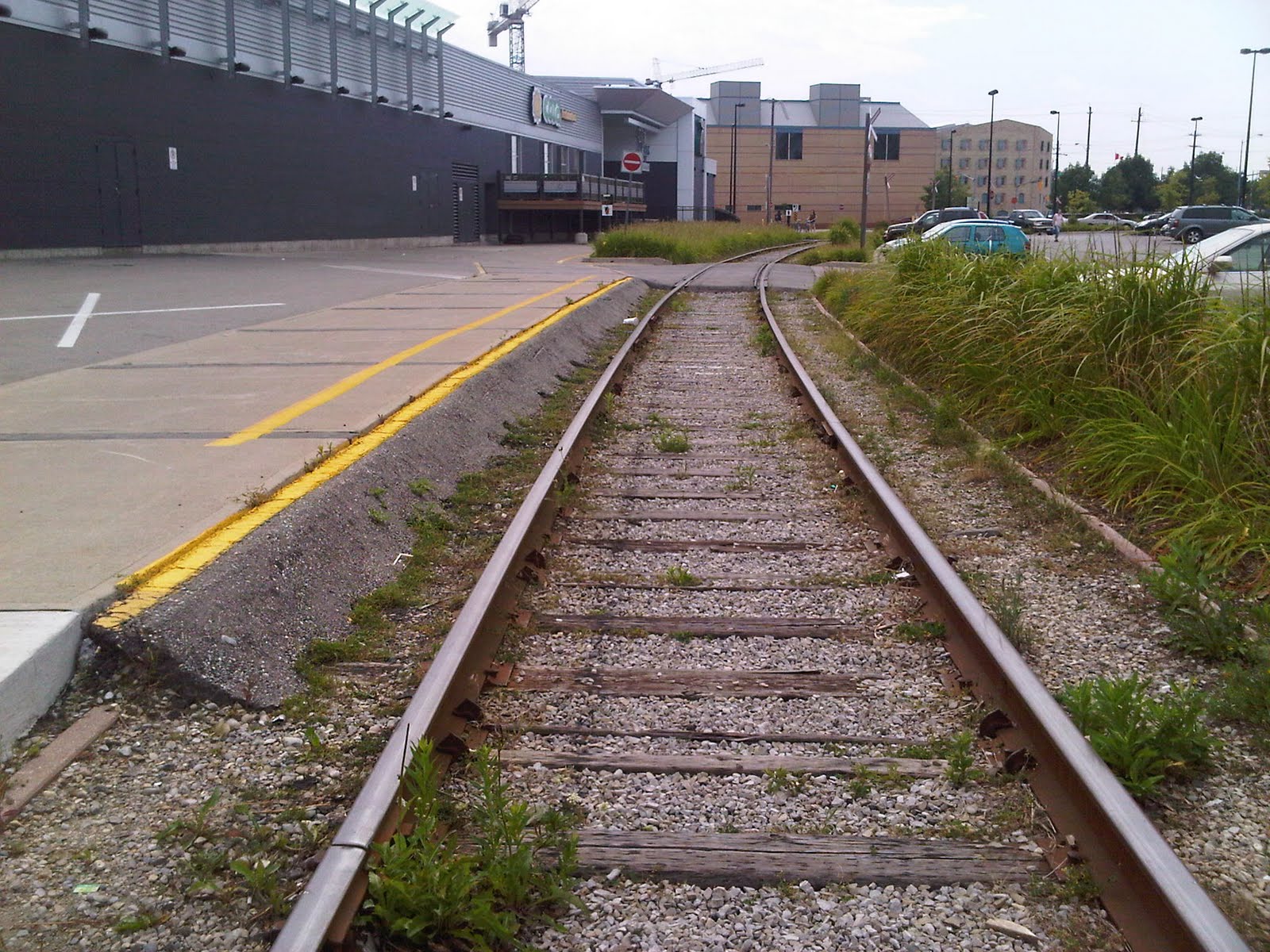
Laurel Trail runs along Laurel Creek and the railway tracks through Uptown Waterloo, Waterloo Park, and the University of Waterloo. It's a beautiful trail and my bike route to work. Here's a particularly pretty spot:

In recent years, the city of Waterloo planted flowers where the trail used to be along the tracks from Caroline to King. From the Waterloo Square north parking lot, here's where the trail used to be, east to King:

...and where the trail used to be, west to Caroline:

I guess City Hall figured that people following the trail can walk on the tracks or in the parking lot. That's a real pain for bicyclists and roller bladers. Also, the break in continuity is a problem for what is already a poorly marked trail.

Laurel Trail should be clearly marked, be paved, and have snow removal - not be a hodgepodge of unmarked segments of path.

The Iron Horse Trail is also abandoned as it goes through Uptown, picking up as it exits each end. Trails should be showcased in Uptown, not abandoned!

###

Saturday, August 07, 2010

Empty Lakes and Concrete Canyons

I snapped this picture of Silver Lake in Waterloo Park yesterday. I was standing on the foot bridge at the western edge of the lake.


In case you're wondering, that dry land is part of the "lake". Water levels in creeks and rivers around the area are fairly high now, even though it's the middle of summer. Not so with Laurel Creek in Waterloo.

A few decades ago, amid concerns that water levels would rise, the city of Waterloo lined creek beds in ghastly-looking blocks of rocks encased in chicken wire. I remember when they did that to Laurel Creek near Marshall, destroying beautiful banks, trees, and plants. You could see the wheel treads of the bulldozers for years. A beautiful burbling brook became a hideous mess.

The park behind Waterloo City Hall got the full treatment: Laurel Creek was buried at the bottom of a concrete canyon:


A block away, just across Erb Street in a less heavily travelled area, Laurel creek is in its natural banks again:


Former mayor Joan McKinnon told me that the water projections of forty years ago turned out to be incorrect, and Laurel Creek has instead dropped in volume. I wonder if there's any way to boost it.

We could have a beautiful (and cooler) uptown if we made the most of Laurel Creek. A hundred years ago Silver Lake was a popular swimming spot; we might not achieve that again, but it could be a pretty place if it had water and maybe even a fountain. Laurel Creek behind City Hall should be naturalized with willow trees hanging over it and rounded grassy banks. It may never be as spectacular as the rushing creek that runs through downtown Boulder, Colorado, but it could be a lovely urban park.

###

Thursday, July 01, 2010

Cleanup efforts

Immediately after the Deepwater Horizon oil rig blew up and it was known that oil was gushing into the Gulf of Mexico, people around the world started offering assistance to clean up the oil. There are many countries that have skimmers that can remove oil from water far more efficiently than any US technology can do it. A great unexplained scandal is why they have not yet been allowed to help, but it seems to have to do with overly cautious US bureaucracy. Now that hurricane season has arrived (and it's predicted to be a bad one), there will not be as many opportunities for skimming oil.

The first good news has arrived in the form of a Taiwanese tanker that [it is hoped] can scoop up 21 million gallons of water a day, separate out most of the oil and siphon it to a nearby ship, then put the cleaner water back in the Gulf. However, even it needs to wait approval from the Environmental Protection Agency, as current regulations won't allow it to put dirty water back in the Gulf - even if it's cleaner.

###

How much oil has spilled?

Since the Deepwater Horizon drilling rig blew up on April 20 until today (July 1), various estimates put the amount of oil that has gushed into the Gulf of Mexico at between 100 million and 200 million US gallons. Some of the oil has been siphoned, burned or skimmed from the water. The current official estimate of the remaining oil in the Gulf as of Thursday was 140 million gallons. It is estimated that 1.4 to 2.7 million gallons is being added to that each day.

###

Why is the Gulf Oil Spill Different Colors?

When I was collecting photos of the Gulf oil spill recently, I was puzzled why some of the pictures showed red oil, while some was the usual iridescent black.

Turns out oil turns red when mixed with water. Wierd Koops, chairman of Spill Response Group Holland, says, "the red-brown color happens when oil picks up more than 60 percent water."

###

What Will Happen to All that Oil From the Gulf Oil Spill?

Some of the oil that has gushed into the Gulf of Mexico is being reclaimed by BP. The rule of thumb seems to be that if it has turned red, the oil is too "weathered" to be commercially viable, but if it's still black it may be salvagable with processing.

In a gigantic rescue effort, a small amount of the oil has been brought ashore manually - by boats and by people bending over and picking it up off beaches. The oil in liquid form will be put in injection wells, while contaminated solid waste will go to special landfills.

As part of the cleanup effort, some of the oil on the surface of the water has been set on fire.

The Automated Data Inquiry for Oil Spills predicts that about 35 percent of the remaining oil will evaporate, about 20 percent will find its way to the ocean, and roughly half will remain in the Gulf of Mexico - some on the surface and the rest dispersed throughout the water.

The oil that goes to the ocean will round the tip of Florida and then probably get caught up in the northward-flowing Gulf Stream. Simulations predict that that oil will flow close to the coast of North America.

The Gulf Stream eventually finds its way to the Norwegian Sea, where the cooled water becomes heavy and sinks to the bottom of the ocean. The trip from Florida to the sink will take about 18 months (based on this analysis of how long ashes dumped in Fort Lauderdale will take to get to England). After sinking in the Norwegian Sea, the Gulf Stream waters flow back south and reappear in the Pacific about 1,600 years later.

Some or all of the oil in the Gulf Stream will drop off en route. Tar balls may wash ashore. The oil may foul beaches and fisheries all up the east coast, although the simulations predict it will veer offshore long before Canada. Some of the oil will disperse in the Atlantic or sink to the bottom - which is reputedly already littered with tar balls from other oil spills and from chronic oil leakage from practices like dock degreasing.

A hurricane, tropical storm, or even plain old high winds could cause several problems.

High winds could dislodge or destroy the booms that are containing some of the oil, causing the slick to spread further. They would also likely cause large waves that will drive more oil ashore.

Storm surge could drive contaminated water up canals and rivers. (It was storm surge that caused the flooding of New Orleans in the hours and days after Katrina.) A major concern in New Orleans is that the contaminated water will reach Lake Pontchartrain.

The oil itself is a deadly carcinogen, and the tons of dispersants that have been dropped on the slick make it even more toxic. It might seem insane to add more poisons to the mix, until we get to the next hurricane problem - which requires that we get oil off the surface as quickly as possible, and which is the reason for the dispersants.

The biggest concern about hurricanes is that the toxic mess will be picked up by the wind and carried inland. It could be carried hundreds or even thousands of miles before it's dropped on crops and pastures (from which it will spread throughout the food chain) and it will contaminate lakes, rivers, reservoirs and the rest of the water supply.

Of the oil that remains in the Gulf, some will stay in the water forever. Some of it will seep onshore, especially into the salt water marshes that stretch inland for a hundred miles in places. Hurricanes, storm surges and other forces of nature will continue to carry it further inland, possibly for decades to come.

Many people seem to think that BP can pay the costs of the oil spill's damage, but this is way too big for a single company to cover.

(The comic is from xkcd.)

###

Oil Spills

Let's all keep in mind that the BP oil spill is a big story because it's close to home and because it's a follow-up to the even bigger (in terms of newstand revenue) story of the Katrina disaster. Oil contamination of the oceans goes on all the time, and is greatly under-reported.

Nigeria has been devastated by oil for decades. The New York Times reports that an oil spill the size of the Exxon Valdez has happened every year for 50 years in the oil fields of Nigeria, with the oil gushing into sensitive wet lands. A recent article in The Guardian is even more devastating, saying that life expectancy has plummeted in rural Nigeria as the oil spills contaminate drinking water. Protest has been brutally repressed, epitomized by the horrific execution of poet Ken Saro-Wiwa in 1995. (Due to outrage at that atrocity, Shell finally paid $15M for its involvement, which was just one in a long history of human rights violations perpetrated by and for the oil companies.)

Like the Gulf spill, Nigerian oil spills don't just affect the local ecology. The oil flows out the Niger delta and into the Atlantic ocean. Also, over half of Nigerian oil wells are off-shore, and they're no safer than the ones on land.

Mexico had an oil spill in 1979-80 that held the previous record (140 million US gallons) and was only surpassed by BP today, at least according to current official estimates.

Tankers have spills at sea all the time that cause barely a ripple of notice.

Chronic oil pollution activities such as degreasing docks has also been chronicled as causing major environmental damage everywhere that oil is shipped.

Years ago I read an interview with a deep sea explorer who said that tar balls litter the floors of our oceans.

(There are also natural oil leaks, like Bush Hill in the Gulf of Mexico, but they generally become part of an ecosystem: the oil and gas is eaten by bacteria, which are in turn eaten by things like worms and mussels. Still, they sometimes result in tar balls washing on to beaches.)
###

The Singularity Happened... and I Missed It!

Why should we accept that transformative change can only be caused by artificial intelligence or genetic modification of the brain or encounters with aliens? What if it's something so profound that we're not able to predict it or even realize, at the time, that it's happened? What if it's something not even dreamed of by Ray Kurzweil or Charles Stross?

Old-timey sci-fi writers John Wyndham, Charles Harness and Theodore Sturgeon saw the future as human evolution. In More than Human, Sturgeon saw evolution as not just the development of psychic abilities but also the creation of multi-person organisms, leading to the next stage of man, homo gestalt.

In one of my [many] favorite sci-fi novels, Nancy Kress's Beggars in Spain, there's a sort-of singularity (arguably it's not fast or profound enough, but it's the same idea) that's a confluence of three events: breakthroughs in human genetic engineering, the invention of cold fusion, and a popular new religion that preaches libertarianism.

Female authors Margaret Atwood and P.D. James envision a future where a failed ability to reproduce is the cause of massive change. I don't see futurism as a feminist issue, but they do suggest a different direction - and the paranoia that we won't wake up to the change until it's too late. I suppose you could translate that paranoia to the singularity idea by suspecting that aliens are already among us, changing things quietly under the covers. Or maybe we simply can't comprehend the change that's happening to us personally, as I can't differentiate my personal development from the societal changes happening during my childhood in the 60s and 70s.

In Stross's worlds a singularity is akin to an apocalypse: overnight society crumbles and most people die. That's not an event that people would fail to notice. (Unless it didn't happen in the northern hemisphere, or wasn't good at selling papers?)

###

Thursday, June 24, 2010

Bribing Canadian Politicians

Richard Fadden, the head of the Canadian Security Intelligence Service (CSIS), is in the news this week spilling some very important information: the Chinese government is paying Canadian politicians to spy for it.

It seems clear to me that this was no mistake: he went to the CBC interview to give this information. He must have known that he was risking his career to say this. I suspect he felt it was important for the public to know. Why would he do that? Because we vote in politicians, and once in office there's little that can be done to prevent this sort of thing. The head of CSIS probably weighed his options and decided that the only way to successfully address the issue was to make it public.

The news spin has been about everything but the main issue.

On The Current this morning, Anna Maria Tremonti focused on how this is a slur on the Chinese community in Canada.

Today's Globe has a column about how heads should roll at the CBC because they delayed broadcasting the interview until the eve of the arrival of the Chinese head of state.

Maclean's attacks the whistle blower, saying that his backpedaling is "awkward" and a "ragged retreat".

Is this willful denial, or are serious news outlets - as I hope - sending out investigative journalists to follow up on this story and get us some facts?

And kudos to the CBC for airing this interview just before the G20, when it will get picked up by international media. They may have realized that Canadians wouldn't be able to see the forest for the trees.

###

Wednesday, June 23, 2010

Photos of the Gulf Oil Spill

The floor of the Gulf of Mexico, pre-spill:


The surface near the gusher:


Oil approaching a beach in June:


A graph showing where oil has hit land, June 19:


Thousands of individuals are attempting to clean the beaches by hand:


Oil seeping into a salt water marsh:

Tuesday, June 22, 2010

The Plan

Harper's plan seemed to be this:

  • In early summer, host two huge prestigious international meetings (the G20 and G8 summits). Be seen on home soil as top dog among Obama, Cameron, Herkel, et al.
  • A few days later, host the queen. Be seen on home soil as top dog with the lady on the money.
  • While the queen is here, announce the new G-G. Be seen as the guy who appoints the other top dogs.
  • Ride the wave of national pride and personal adulation through the summer (without pesky parliament interfering).

Then, in late August or early September, dissolve parliament and call an election.

This scenario explains a lot.

It explains why Harper was so interested in the G8/20 all of a sudden. This is the guy who was publicly disdainful of these leader get-togethers. This is the guy who showed up late for photo ops and blew off an Obama speech to do a press event at a donut shop. This isn't even a regular meeting - the G20 summit is in November, and this is just an add-on.

It explains the odd wording of the Afghan detainee document deal that would allow Harper to cancel the opposition party's access to the documents if he wins a majority.

It even goes a little towards explaining why he prorogued parliament and then delayed so long on signing the agreement on release of the Afghan documents... his plan was that parliament would have very little time to see those documents before he used his majority to yank them back.

And he almost pulled it off. By now, the Canadian public was supposed to be dazzled by a sense of our growing international importance. By next month, we were supposed to adore the man who made it all happen. Last week Harper's PR team released a photo of him standing alone in the House of Commons, looking pensive. This was just the beginning of a repositioning. I have no doubt that a whole series of photos, events and ads were planned to remake Harper in the eyes of the country. It didn't have to fool everyone, and it didn't have to fool anyone for long - just long enough to win a majority.

It's lovely irony that Harper is hoist by his own petard. To get maximum political benefit from the summits, he let the organizers go hog wild on costs. If the government had managed to hide the costs of the G8/20 summits, we might have had a Conservative majority by Thanksgiving. (Gack - we still might.)

###

Saturday, June 19, 2010

Junk Food for Babies?


Gerber has a line of junk food for babies.

The label says that by 12 months babies are ready for a wider variety of foods. Called Lil Crunchies in the Graduates line, the baby junk food includes cheese puffs, vegetable puffs and fruit puffs.

To add insult to injury, it's really expensive.

###

Friday, June 18, 2010

Dedicated Bike Lanes

Trendy ideas come and go. We all (myself included) have a tendency to get behind an idea that sounds good, even if we haven't completely thought it through.

The latest fad, in Waterloo Region at least, is bike lanes with curbs around them. These, it is thought, will be safer for bicyclists and so increase bike commuting. Sounds good, no? All of a sudden everyone seems to be behind the idea - you hear it all the time, proposed with great authority.

But wait. There are a few other things to consider:

  • Given the much higher cost of this sort of bike lane over a regular bike lane, a shift to the new lanes will almost certainly slow down the development of new bike lanes.
  • The new bike lanes require more space so won't be possible on many roads. This isn't a drawback unless (as I've heard) people decry the regular bike lane as unsafe - then we just end up with less bike lanes.
  • In winter, it will be more difficult to plough these lanes. Regular bike lanes (essentially just a white stripe down the road marking off a lane for bikes) are easier to plough. The city will have to send out a different sort of snow plough to handle the new bike lanes. They likely just won't get ploughed.
  • As a cylist, I don't relish the idea of a curb surrounding my lane because it makes it more difficult for me to merge with traffic to make a left hand turn or get to an address on the other side of the street. It also makes it more difficult to pass slow bike riders and other impediments.
  • The curb alongside the bike lane does not solve the biggest problem of bike lanes: at intersections, bike lanes tend to disappear - leaving the cyclist high and dry in the most dangerous part of the street. This problem will probably be much worse with curbed bike lanes, as the curb will have to stop at every spot where cars need to turn.
  • Curbed bike lanes only make sense on streets with limited car access - long stretches of road without intersections or driveways. But in those situations, a path running a few meters away from the road is a safer and more enjoyable alternative for bikes.
  • There is an accessibilty consideration: how do pedestrians with walkers, baby buggies or wheelchairs cross them? What about the sight impaired?

The curbed bike lane idea may be made with the best of intentions, but it may also be a very negative force on the future of urban cycling. We'd be better off itemizing the problems with regular bike lanes and thinking up better ways to solve them: motorists parking in bike lanes; lanes running close to parked cars with doors that could suddenly fling open; safe ways for bikes to make turns and cross intersections; etc. And the number one priority is just to have more trails, paths and bike lanes, and to make sure they connect.

###

Saturday, June 12, 2010

Maybe Not a Merger - But Cooperation, For Sure

The 2008 coalition was impossible because there was no-one in place to lead it. Dion was so weak that he was ousted, and then Ignatieff was merely He Who Would Be Acclaimed. He couldn't take over as PM before a convention making him Liberal leader.

Harper and the boys spent a lot of money trying to convince Canadians that the very notion of a coalition is undemocratic, and that one in our current political environment would be doubly undemocratic because Liberals would have to join with "socialists and separatists." It was McArthyesque, but it resonated, despite the well-documented attempt at a coalition initiated by Harper himself in 2004.

The problem was how to ever get out of this hole. Many Canadians had bought the line that a coalition would be a coup d'etat - hell, The Economist even used the word coup to describe it (although that word didn't reappear in their analysis of their own country's current coalition).

Enter Jean Chretien, circa last week, musing about the possibility of a merger between the Liberals and the NDP. All of a sudden mergers and coalitions have resurged as a topic of discussion - and this time Harper isn't setting the agenda. This discussion has the potential to clear away some of the paranoia about center-left cooperation.

Harper is doing his best not to let it. This week the PMO/PCO has tried attacking the president of the Liberal party, creating a bunch of nutty fake quotes and so on. It's typical Conservative smear tactics, but it has a hint of desperation to it. And at the same time, Conservatives are slipping in the polls (not that that means much).

Perhaps I'm giving Chretien too much credit, but he may have been crazy like a fox in starting up merger talk. It may do all kinds of good for all nonCon parties.

Personally, I'm not pro-merger. I think it would be good for the Liberals (my party), not just because it would let us win a lot of ridings where the Liberals and NDP split the vote, but also because I'd like to see the Liberal party move left, and I have a lot of respect for New Democrats - especially a lot of current senior NDP MPs like Pat Martin, Olivia Chow, Thomas Mulclair and others. I'm against a merger because I don't want to see the NDP vanish.

However, maybe there are solutions to merging and not killing the NDP. Maybe the NDP could exist as a mini-caucus within the Liberal party. Or maybe a cooperation accord could be signed that was part coalition, part merger. I have no idea what sorts of arrangements are acceptable in the Westminster parliamentary system, which of course I would want to adhere to. Also - if the NDP decided it wanted to merge, then as a Liberal I would have to defer to them.

All in all I think it's an interesting and good discussion. For months the headlines have been that the Conservatives are ahead in the polls, when the same statistics could have been reported as that the government is hovering at preposterously low 30% support. The Conservatives get away with it because the rest of us are split, and the rest of us have more uniting us than dividing us. I'd prefer a coalition, but any talk that gets us closer to cooperating is fine by me.

Conservatives are in desperate attack mode because center-left cooperation is a major threat to them. It's quite possible that the Liberals can beat them on their own in the next election, but the more we present a united opposition, the more the Conservatives have to fear.

Update: Media pundits keep saying that coalition talk is something that has been done to Ignatieff. I disagree. Chretien and Romanow may be loose cannons, but Bob Rae didn't write a piece about his experience in a coalition without the approval - and probably the direction - of Michael Ignatieff.

###

Sunday, June 06, 2010

Measured in Millihelens

The Iliad has two heroes: one nominal (Achilles) and one subversive (Hector). Achilles has to be the hero because Homer's audience was Greek and Achilles is Greek (Achaean), whereas Hector the Trojan prince was the enemy to the Greeks in the Trojan war. Achilles is certainly a hero - but he sulks in his tent and fights in blind anger. In Homer's lifetime there were no Trojans left to cheer on Hector. Just to solidify our preference for Hector over Achilles, Achilles is most unheroic in his treatment of Hector's dead body after he kills him - and Achilles' blind anger and revenge-killing of Hector is not very heroic, either.

So instead of black and white, at the center of the Illiad is an odd take on us-and-them: we are great but flawed. The unattainable standard of heroism is embodied in the other. More: we destroyed the ideal hero (Hector). The nominal hero, Achilles, lives on - an interesting ploy of Homer's, as Achilles lives only because Homer stopped the tale shortly before Achilles' death. (In other versions of the story he dies during the sacking of Troy.)

On a macro level the Iliad is also subversive. While it is a book that celebrates a great Greek victory, the prominence and glorification of Hector implies that the Greeks were wrong in fighting the war. There is great sadness in the destruction of Hector and his civilization, and the Greeks come off as brutes.

There is a humanism in the Iliad that you seldom see in historical fiction. No man dies anonymously. If a man dies in the Iliad, the means of his death is described, as is the name of his father and something of his history. This makes it a bit bloody, for sure (some might say there are endless descriptions of ghastly fatal wounds), but it is also very respectful of life.

Achilles doesn't refuse to fight because of any moral qualms; he's just mad that Agamemnon has taken his slave-girl Briseis away. Achilles didn't want any part of this expedition in the first place, but was forced to go. Hector is forced to defend his city, but wants only a peaceful life with his wife and young son. Despite the bloodiness of the story, the Iliad is profoundly anti-war.

All this makes sense when you think that Homer (or a collection of writers we call Homer) was writing at the end of the dark ages and is describing the cause of the dark ages (as I've argued before). You could see the central premise of the Iliad as: The heroic deeds of our (Greek) heroes resulted in hundreds of years when civilization died.

Okay, if you got this far, here's a little Illiad joke to reward you:

Q: What's a millihelen?
A: The amount of beauty sufficient to launch one ship.

###

Sunday, May 23, 2010

Snooks

"Snooks" is cool-guy lingo for "sonic dematerializer," a "next-gen weapon" that provides the premise (such as it is) for the recent film The Losers. The Losers is based on graphic novels by Andy Diggle, but as far as I can tell the slang "snooks" is wholly an invention of the film.

According to the movie, snooks are the weapon of choice of modern-day bad guys because they are environmentally friendly. The film's arch-villain, played by Jason Patric, says they "produce no pollution - they're pure destruction" and so are highly sought-after by eco-terrorists. When asked about other next-gen weapons, Patric airily asks, "Have you heard of deep-space tachyons? Singularity events? No?" and he arches an eyebrow to let us know that if we don't have the science, there's no point trying to explain.

Me, I'm so old school that when you put "graphic novel" and "sonic dematerializer" together I think of Madame Castiofore, the glass-shattering opera singer in Tintin. On its own, "sonic dematerializer" makes me think of that gizmo that dental hygenists use if you forget to floss. I seem to recall in the 1960s series The Prisoner that Number Six was kept in The Village by means of a sonic weapon of some sort - they make for excellent low-budget special effects because all you have to do is shake the camera a little, have the actors grab their ears, and then have something vanish. In fact, the mad scientist in Help! tries to get Ringo's ring off with a sonic dematerializer, causing his pants to fall down and fuses to blow. (When the fuse blows John Lennon says, "My god! What's your electricity bill like?" and the scientist's assistant, Algernon, says, "Well it's sort of a long counterfoil...")

All in all, the destructive power of sound seems pretty last-gen to me (maybe even retro-gen). But I like this word snooks. Snooks even sounds like a good nickname for the old prima donna.

The idea that the next generation of terrorists is going to require environmentally friendly bombs is just, well, delightful. It's a great shame that the movie was so dumbed-down that they made no attempt to explain how the arch-villain would wield a singularity event as a weapon, not to mention how he'd harness the elusive tachyon. All we see of the snook is an island that gets obliterated, and you think you could do that for less than $1 billion cash.

By the way, The Losers is a really bad film with really good acting by everyone in it. It's a great shame that so much talent wasted nearly a year creating such a bag of crap. I saw it only because I thought there would be superheroes.

###

Sunday, May 02, 2010

Ending Wagner

At the very end of the Ring Cycle there is a brief moment when we see that the age of the gods is over and the age of humanity is beginning. It only lasts a couple of minutes but it is of vital importance to the piece - all the fighting of the gods leads to this, the making of humanity. After 17+ hours, the audience can finally exhale. The leitmotif that plays at the end makes this very clear. A production that doesn't recognize it makes a big mistake. I know - I saw one once: it was a deflating experience.

At the end of The Flying Dutchman, when the young woman Senta is shot dead, the music suddenly changes from dark and menacing to romantic and optimistic. It only lasts a moment, but that music ends the opera. It is clear that Wagner intends that Senta and the flying Dutchman are both saved by her death: he has been cursed to immortal life on the sea, and can only be saved by a woman who promises and delivers on loving him until her death. She promised him her love, and continued loving him until her death.

It is unfortunate that the COC production of The Flying Dutchman, mounted in 2000 and currently being revived at the Four Seasons Center, misses the ending - either misses it, or handles it so subtlely that the audience misses it. Senta just falls down dead, and the Dutchman walks up a staircase holding her wedding veil, but that's it.

I can see that it's difficult to do justice to these brief but monumental Wagner endings, but opera productions must.

###