Showing posts with label Waterloo. Show all posts

Sunday, November 30, 2014

Horrible Regional Signage is Causing Construction Chaos

The Ion LRT is going to take three long years to build, three years of construction and traffic jams, three years of mud, three years of inconvenience and unpleasantness. The process started a few weeks ago, and I live in the epicenter of it. The Region has got to improve their signage.

Here is an example: Caroline Street is torn up from Allen to Erb. Park Street has no construction. However, there are signs along Park Street saying, "ROAD CLOSED LOCAL TRAFFIC ONLY". Here is Park at Union (construction starts three blocks away from here):


The signs on Park should not say "ROAD CLOSED LOCAL TRAFFIC ONLY". They should say something like "Caroline Street closed from Erb to Allen". Here's another confusing "ROAD CLOSED" on Park, this one near Allen:


You might think that the arrow is supposed to show that the road closure is to the right, but look at this signage on Alexandra at Euclid, which is showing that the road behind the sign is closed ahead:


In fact, the arrow directions (up, down, left, right) used in the road closed signs are inconsistent and confusing. I'm not sure about the placement of the signs in the road either. On Alexandra, they blocked the east-bound lane with a "ROAD CLOSED" sign and traffic cones, even though I have to turn there to get to my home. (A local resident kindly moved the sign to the curb so we can get by.)

Here is another example. Alexandra Street is not torn up, but it is blocked at Caroline. At the next intersection to the west, there are three ROAD CLOSED signs. Any law-abiding person driving east on Alexandra will think, as they approach Euclid, that they have to turn around and go back. On Euclid heading to the left and right there are signs saying "ROAD CLOSED LOCAL TRAFFIC ONLY" and straight ahead on Alexandra there's a sign saying simply "ROAD CLOSED". It's a little difficult to see, but here's a photo taken from Alexandra looking east at the intersection with Euclid, showing "ROAD CLOSED" signs in every direction:


I have to drive past the "ROAD CLOSED" sign on Alexandra at Euclid every day, because I live on Alexandra between Euclid and Caroline. That sign should also say "LOCAL TRAFFIC ONLY". People living on Alexandra and Short Street have to drive through there.

The Euclid signage saying "ROAD CLOSED LOCAL TRAFFIC ONLY" appears all along Euclid even though there is no construction on or near Euclid - the signs were put up in an attempt to keep cars from cutting through on Euclid. When I complained to the Region about it I got an email saying it was required by community safety. Fair enough, but the signage should NOT say "ROAD CLOSED" when the road is not closed. When a motorist drives on a road that has been signed as closed, their insurance can be denied if they have an accident. They can be stopped by the police. The Region could put up signs saying "LOCAL TRAFFIC ONLY" but it is madness to tell us that the road is closed when the road is not obstructed.

Strangely, on Caroline at Allen, where the Caroline road closure begins, there is no signage at all. Same thing at Caroline and Alexandra: there's nary a "ROAD CLOSED" sign, and in fact confused drivers have been driving along Caroline on the dirt track the construction trucks use.

Finally, here's a map showing the current construction.

  • The yellow line shows where Caroline is closed.
  • The yellow line with red dashes shows where a road is partially closed.
  • The red X's show where there are "ROAD CLOSED" signs. (I missed quite a few: for example there is also one at William and Westmount, nine blocks from any construction.) Note that these red X's are places that say "ROAD CLOSED", implying that the current road is closed.
  • The blue X shows where I live.
It is going to be a long, long three years. Currently, the Region is tearing up Caroline to move the pipes so they won't be under the LRT tracks. Then they'll repave. Then they'll tear up the road to lay the tracks. I think my new mantra should be, "Where do you live?" "I live at You-Can't-Get-There-From-Here".

Monday, September 01, 2014

King & University: a traffic problem?


Taxi drivers are saying that they are risking their lives to pick up and drop off passengers outside the new high rises on King Street north of University Ave. The problem is that the buildings have no pull-in area so cabs have to stop on busy King Street. I have noticed private cars stopping on the street to pick people up, too.

Monday, February 03, 2014

Waterloo needs a west-side expressway

Rush hour traffic in uptown Waterloo is a mess. Some of the busiest intersections - William/Caroline, Erb/Caroline - are going to get even worse when the LRT goes through them.

What we need to relieve the congestion in uptown is an expressway, or at least a rapid road, on the west side of town. Currently the Conestoga Parkway (shown in yellow below) is only two-thirds of a ring road.
In recent years much of our growth has been in the north-west, an area not serviced by the Conestoga Parkway. People in those subdivisions clog up Erb and University getting to the parkway, and a lot of them drive across the uptown getting there.

As more and more condos are built in the uptown, too much of that commuter traffic is heading east, putting pressure on Park, William, Caroline, and other streets that feed onto the Conestoga Parkway. If more of that traffic could be funnelled west, much pressure would be relieved.

A few years ago it was widely believed that Ira Needles Boulevard would be the west side rapid road, but then it was lined with dozens of big box stores and it can barely support local traffic. Our options are more limited now, but there has to be a solution.

Saturday, November 09, 2013

King & University: Density node? Neighborhood? Mess?

The density at King & University has been a long time coming. When I was a teenager in the 70s there were already large apartment buildings on Regina Street North. University Avenue in the King-Regina area has been steadily growing with apartments and strip malls. WLU is building more and more student residences in the area.

We now have one of the densest parts of the region (perhaps the densest in Waterloo) located at King & University, and it's difficult to see any coordination or planning whatsoever. It's the node that Waterloo City Hall forgot.

The intersection at King & University is one of the most dangerous in the Region. In 2012 there were 41,000 vehicles and 6,000 pedestrians using the intersection each day, and there were 130 collisions, including 11 involving pedestrians. (link) City Council recently debated installing a pedestrian scramble there but decided not to, apparently because it would cause even greater traffic delays.

Both King and University are major routes for drivers going cross town. The intersection is a bottleneck, largely because of the lack of a right turn lane for traffic heading south on King turning west on University. Traffic backs up because those right-turners have to wait for all the pedestrians to clear the crosswalk.

It's a real problem that such a dense neighborhood lacks a grocery store. The area was recently reduced to just one corner store when Forwells threw in the towel. And there are other amenities that should be apportioned to neighborhoods, such as a park. For the student population, you'd think a beer store would be appreciated. For non-students, some sort of sports field or playground might be useful.

There are some student eateries in the area (notably Frat Burger, Burrito Boyz, Morty's, and a Starbucks), but the retail shopping is not aimed at the local population or pedestrians in general. There is an automotive repair place, a store that sells 20-liter bottles of water, specialty medical buildings.

For pedestrians, the area is inconvenient and unpleasant. The sidewalks abut against the street. The strip malls have large parking lots out front. The stores are widely spaced. And then there's that dangerous intersection, which is no fun at all to cross.

The City of Waterloo can't help that the Region decided to make the LRT bypass King & University: the Region was bound and determined to route the LRT through the UW campus so that its ridership numbers will be bolstered by students with free transit passes. But the city has to do something to improve the King & University neighborhood. For starters, it needs a name. Next, it needs a vision. Then it needs a plan.

Maybe we need to restrict cars from turning off of King and/or University. Add pedestrian islands in the crosswalks. The area could use a streetscape improvement plan with better sidewalks, planters, trees, and benches. A beer store could perhaps anchor a development with a grocer's. It's all going to be time consuming and expensive, but it's too important an area to overlook any longer. Just consider how much time and money Waterloo has spent on Claire Lake (a pond in a wealthy subdivision) or the Clay & Glass Museum (which practically nobody goes to except school children who have no choice).

And almost more important than anything else, if we built a proper hiway on the west side of Waterloo, we could hugely reduce the traffic that floods down University and Erb to the Conestoga Parkway - a hiway that connects major arteries like the 401 with the east side of town.

Before any decisions are made, we need a solid understanding of the neighborhood now and in the future. Think you know everything? This is being built just a couple of blocks away:

Update, January 10, 2014:
I drove down King from Columbia to William last Thursday around 10 PM. In the area from Hickory to Lodge there were masses of people on the snowy sidewalks. The uptown had less than half as many people, even including those at the skating rink in Waterloo Square.

Tuesday, November 05, 2013

Will/Should John Chen move BlackBerry to California?

I worked at Sybase for eight years under John Chen, the new CEO of BlackBerry. He was an interesting CEO - refreshingly (almost appallingly) frank. I remember he once came to the Waterloo office and told us that our market was shrinking, and that he felt like the captain of a leaky boat that was destined to sink. It seemed like Sybase did pretty well under Chen.

Another thing I remember, I think correctly, is that Chen moved the California HQ of Sybase from one town to another about an hour's drive away. This greatly upset the many employees who had purchased homes around the initial office, especially because the new building was close to Chen's house.

All this got me thinking about the future of BlackBerry under Chen. The best thing for BlackBerry might be a move to California, for lots of reasons.

BlackBerry isn't going to survive unless it can change its corporate culture. RIM got whammied with a perfect shitstorm that created that culture: the lawsuit, the hyper growth, the duality at the top. There are still too many people at BlackBerry - especially leaders - who don't sufficiently value productivity and quality. By moving the company, Chen could switch out a lot of the current personnel with Californians, thus transforming the culture relatively quickly.

Another factor is the corporate culture of Waterloo. How can I put this delicately... oh hang it: in Waterloo, many people work to live rather than live to work. That's great: their priority is their families and friends. But all too often, ambition in Waterloo is a sense of entitlement; there often isn't the right environment to hone and select the best leaders.

Waterloo is a great place for a development office, what with all the high class talent coming out of the University of Waterloo, but it might not be the best place to headquarter a large, cutting edge tech firm. We have so many startups here that the corporate culture might change, but for now, California could be BlackBerry's best bet.

(With apologies to the many brilliant people I have worked with in Waterloo.)

Monday, September 02, 2013

Let's rethink the St Jacobs Farmer's Market

Waterloo woke this morning to the sad news that the main building of the St Jacobs Farmer's Market had burned to the ground. Already there is an outpouring of sympathy and support to the owner, Mercedes Corp. I am afraid that this post has a somewhat different tone. I see this tragedy as an opportunity to rethink our approach to the market - and make some substantive changes.

In a 2009 post (Market Memories) I was quite critical of Mercedes Corp. I wrote that post when Mercedes shut down the Waterloo Mennonite market and moved the vendors across the street to their tourist-oriented site, which locals historically called the Stockyards. That site is now our sole farmer's market - the St Jacob's Farmer's Market - and is the site of last night's fire.

A farmer's market is part of our heritage, an important part of our economy, and a vital link between the rural and urban parts of our community. It is much more than a tourist attraction. It is a resource for the community: for farmers and small businesses to sell their goods, and for people to purchase locally-made food and other items.

Mercedes Corp did not invent the market. We always had one. Mercedes Corp was somehow able to purchase the market, but many of the shoppers and best vendors predate Mercedes. Over the years I have increasingly felt that the market should not be in private hands, or at the least should be more influenced by the needs of its stakeholders.

My particular concerns are:

1. I am concerned that Mercedes Corp does not provide a fair environment for the vendors. The vendors seem to have no security - apparently they can be (and are) moved or kicked out without notice. I haven't asked vendors recently about the price they pay to have stands at the market, but a few years ago they said that the prices were doubling and then tripling. The vendors are rationally afraid to speak out, but the ones I talk to say that their sales have dropped as the number of visitors increase: the marketing strategy of Mercedes Corp has attracted too many non-shopping tourists, or people who are there for cheap sunglasses and tube socks. This isn't a new problem, but it continues to get worse.

2. I am concerned that Mercedes Corp does not provide a safe and convenient environment for shoppers. The aisles are too narrow for the crowds. That means that people waiting to buy on both sides of the aisle leave only a narrow space for people trying to move down the middle. The problem is compounded by the many enormous baby buggies. The overcrowding isn't just inconvenient; it's unsafe: God forbid something happen during market hours. (The new building should have wider aisles or it should have bollards that prevent non-pedestrians from entering the shopping aisles.)

3. I am concerned that the business model of the current market allows only for vendor-businesses, and shuts out homegrown initiatives. I remember one summer buying sweet peas from two teenage boys who had created summer jobs for themselves by planting a lot of flowers and renting a table at the market for part of the summer. You used to see a lot of that sort of thing, but the current market seems to have no amateur or short-term vendors.

4. I am concerned that the market is no longer Mennonite-friendly. There are fewer and fewer Old Order Mennonites there, although there appear to be some vendors who impersonate Mennonites (heavy eye make-up under a bonnet is a suspicious clue).

I'm 55 now. I've been shopping at Waterloo's farmer's markets since I was 7, and I still go to the St Jacobs market weekly. I do hope that the building will be replaced speedily, for the good of the vendors, the shoppers, and Mercedes Corp. I strongly believe that the new market needs to be more attentive to the needs of its stakeholders, but I fear that Mercedes Corp will use this opportunity to make the market even more commercial and take it even further from its roots.

See also my 2009 post: Market Memories.

Monday, August 05, 2013

More for Uptown, Part 2: Parks at King and William

At the corner of King and William there are two little parks of identical size and shape. This one, on the east side of King, is called Heritage Green. You can see Knox Presbyterian church in the background. Some years ago the park was partly covered in concrete in an attempt to create an impromptu performance space (a nice idea that unfortunately failed completely). Locals call this park "the bunker". The concrete is full of weeds. I have never seen anyone using this park.


The other park, on the west side of King, is called Brewmeister Green. You can see the Terrace on the Square retirement home in the background. The main features of the park are a Glockenspiel (in the gazebo; it has been broken for many years) and a fountain.

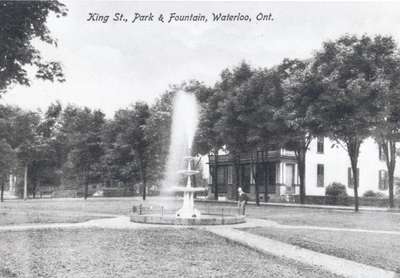
Brewmeister Green used to be called Kuntz Brewery Park. The current fountain (built in 1950, but lost in the greenery for many years) is small and plain. Historically it was a larger fountain and was a popular place to cool off. Here are some photos of Kuntz Brewery Park from 1900-1925:


I think Brewmeister Green is used a little bit more than Heritage Green, and I imagine it's a nice resource for the people in the retirement home, even if it's only to look out the window. Both parks have some mature trees and lovely flower plantings.

A few years ago, a local group raised funds to erect a giant obelisk in Heritage Green. The obelisk was going to portray our history in carvings from the bottom to the top. I saw details of the plans and I (along with many others) thought the finished piece would be a terrible mistake. (Luckily City Council killed the idea.) The concrete in Heritage Green and the Glockenspiel/gazebo in Brewmeister Green seem like similar well-intentioned but dubious ideas.

These two identically sized parks, positioned at a major intersection in the uptown, provide a fantastic opportunity both aesthetically and to provide greenspace for uptown residents, workers and visitors. They also provide an opportunity to regain our heritage.

My suggestion for the parks is to decide on goals, which I propose as:
  • Make the parks address the wants and needs of local residents and workers.
  • Preserve existing trees.
  • Regain heritage features and uses.
  • Create an attractive harmonized look for the two parks.
I would proceed as follows:
  • Watch the parks at various times of day to see how they're being used now (if they are).
  • Survey local residents and workers to find out how they'd use the park. Would workers eat lunch there? Would residents use it? And so on.
  • Do research to find more about the history of the parks.
  • Ask all residents of Waterloo for opinions and designs.
  • Hire a professional park architect to design the spaces.
Just for fun, here's a fragment of a 1908 map of uptown Waterloo, showing the two parks (called "Public Squares" here). King Street is unmarked in the middle.

Demand more for uptown

Development in Waterloo is booming. Four large high-rises are going up: 144 Park, 155 Caroline, a condo building in the Barrelyards (Erb and Father David Bauer Drive), and a rental building in the Barrelyards. Many projects are recent or almost finished, like 186/8 King South (The Red). Other large high-rises are in the planning stages, like 31 Alexandra Ave.

I have a nagging worry that the pace of development is so fast that there will be negative repercussions, but I am by nature a worrywart and I can't provide any foundation for those concerns.

My major concern is that the city is not being proactive enough to provide amenities to balance all these new residents.

All of the development to date is based on the cachet of the uptown. The small, pricey condos are aimed at well-off people without kids. Many of them are retirees who want to be able to walk to a coffee shop or a restaurant. Many of them are tech workers (like myself) who are seeking a vibrant urban environment.

The sad truth is that the uptown could be a lot more vibrant and a lot more interesting to live in. We have the Public Square, which is great, but let's face it, it's a small expanse of white concrete with a smattering of under-attended programming. Downtown Kitchener, for all its many problems, has always been more vibrant and interesting than uptown Waterloo, and has always had more interesting events.

Waterloo simply needs to up its game. There are so many things we could do:

  • Revitalize King north of Erb with a new streetscape and better parking.
  • Do something spectacular with the Post Office land at King and Bridgeport.
  • Finish the two little parks on the east and west of King, on the south side of William.
  • Revitalize the park east of City Hall (it had flower plantings until a few years ago, and now is just an abandoned area with a cenotaph).
  • Finish the path that follows the railway tracks across Waterloo Square - and in general, connect the trails through the uptown.
  • Beautify the exposed parts of Laurel Creek behind City Hall.
  • Do something spectacular with the Pumping Station on William Street across from Regina.
  • Fix and use the fountain in front of the Parkade at King and Willis Way
  • Make better use of the east-side train station.
  • Add amenities to the Public Square.
  • Engage the public in programming the Public Square. For example, start a citizen's advisory committee to handle part of the programming.
  • Get serious about making the uptown accessible to people with wheelchairs, walkers, and baby push-carts.
  • Get serious - in a pragmatic, not ideological way - about traffic in the uptown.
  • Develop an arts strategy that cuts loose the money-pit that is the Clay and Glass Gallery, and creates some serious artistic attractions in the uptown
To get these things done, City Council has to force developers to pitch in more. The developers don't need any incentive to build in the uptown, and they're getting rich by building here. The recent controversy over moving the Iron Horse Trail left a bad taste in everyone's mouth because it seemed that the developer pulled a fast one on Council, and because Council caved without demanding more in return. What many people don't know is that Council is giving in to developers on lots of other issues: increasing density, reducing surface parking, changing agreed-on setbacks, and so on, which is going to have a profound effect on the livability of the uptown, particularly as density increases.

Despite all the new development Waterloo is strapped, largely because of RIM Park debt and the unplanned costs of the LRT, so we need to be creative in funding. But we can't stop moving forward. The current attractiveness of the uptown is based on vision that was formulated in the 90s. The uptown badly needs visionary leadership that is rooted in the needs and wants of: uptown residents, uptown businesses and workers, and the residents of Waterloo for whom the uptown should be a central resource.

Over the next few posts I'll explore some of these ideas in more detail.

Thursday, March 28, 2013

The class system is alive and well and living at the GRT


(Conestoga College, WLU and UW fares are based on a 4-month term, and I converted that to monthly to compare them to monthly pass prices.)(Update: Perhaps the figure for high school students should be $47, which is the monthly equivalent of a 5-month pass.)

There is something wrong with a system where the privileged are treated to nearly free transit, while the less privileged are forced to pay nearly full fare.

Add to that that the universities are getting a billion dollar train that bypasses most of Waterloo to provide improved comfort to their students, while the Region says it's too poor to create decent bus routes to Conestoga College.

The difference isn't just that one set of students goes to university while the other goes to community college. It's also that the universities are in Waterloo and the community college is in Kitchener.

As a UW alumna and Waterloo resident, I'm ashamed.

Monday, August 20, 2012

RIM Layoffs in Waterloo? Deafening Silence

If you go to Google News and type RIM layoffs and sort by date, you'll see a whole bunch of articles about the recent layoffs in Halifax: exact number (95), how it was done (employees were called to a meeting and told by video conference), how employees feel about how it was done (some are angry), and more.

Last week many hundreds of employees were laid off in Waterloo, a smaller town where layoffs have a larger impact, yet there is not one iota of news about it. Zilch. Zippo. I have heard through the grapevine that whole teams were let go. I have heard that some teams were replaced with low-priced contractors. I have heard that the cuts went very, very deep, but I have no idea of overall numbers.

Waterloo is a town of 100,000 where RIM recently employed over 10,000 people. Layoffs affect commercial real estate, residential real estate, the tax base, the health of most local businesses, the economic optimism of the community, and more. In an earlier post (RIM and Waterloo), I quoted someone as saying that every job at RIM creates seven other local jobs. As a city, we need to know numbers. As a community, we need to know what's happening to our neighbours and acquaintances.

RIM is notoriously careful about publicity. There have been persuasive arguments that, for its own good, RIM should be more transparent in this process (Lessons learned from layoffs in Yahoo Finance).

However, RIM seems to be more opaque than ever about the Waterloo layoffs. There is nary a mention of Waterloo layoffs on forums.crackberry.com or bgr.com/tag/blackberry. I talked to some local media who said they are trying to find out what happened but are still in the dark.

If RIM won't step up, then maybe people who know what's going on should consider speaking up. They could call or email The Record, The Chronicle, CTV or 570 News Radio.

###

Monday, July 02, 2012

RIM and Waterloo

I don't have any argument today, just a report of some things I've read. I have been trying to find information on Waterloo's vulnerability to the problems at RIM.

The Economic Times of India (link) says that nearly one third of the city of Waterloo's office/plant space is owned or leased by RIM. That seems like a lot, but the Waterloo Record supports the figure; it says that RIM occupies 2M SF of office/plant space (mostly in the city of Waterloo) in a total market across Waterloo Region of 12-13M SF.

The Record also says that the local layoff announcements will hit about 3,000 locally. Since our local RIM employee base pre-layoff was about 9,000, that would suggest that around 10% of our office space will become vacant due to this initial contraction of RIM.

The Economic Times also says of Waterloo, "The company has nourished virtually every family here; for, each job at RIM has created seven jobs." I haven't seen this anywhere else; I suppose it could be a general statistic? That figure suggests that the ripple effect of 3,000 layoffs could affect 20,000 other jobs. However, again according to The Record, there are currently 1,300 vacancies at local high-tech companies, which suggests an unemployed pool of more like 1,700, which times 7 is more like 12,000. Our area has some big hitters (Open Text, Sybase, Google, Desire2Learn, etc) as well as about 500 high-tech startups - and great infrastructure for promoting startups. No doubt, some talented RIM employees will not just find other jobs but will also start companies, reducing the ripple effect even further. So the total impact on area employment is unknown.

If anyone has any other info or thoughts, please leave a comment or send me an email.

Meanwhile, a video spoof has Steve Jobs doing a drive-by shooting of a BlackBerry in Uptown Waterloo (link).

Update:
RIM dominates the Waterloo real estate market
Life after RIM: Waterloo Region real estate and RIM
KW Real Estate discussion on Canadian Money Forum

###

Saturday, May 26, 2012

RIM, BlackBerrys and Waterloo

The Globe & Mail announced this morning that RIM is planning large layoffs in the next couple of weeks, probably more than 2,000 of its 16,500 worldwide workforce. I got out just in time: I resigned from RIM so recently that my last day was this week and I haven't even started my new job yet. But I live in Waterloo, and RIM's fate affects all of us here.

(Full disclosure: I do not have any confidential information, and if I did I wouldn't spill it here. But with skin in this game, I have spent a lot of the last year reading the industry analysts and thinking about these issues.)

In a town of 100,000, RIM is the largest employer with nearly 10,000 employees located here. RIM occupies approximately 30 buildings in Waterloo, most in the Phillip-Columbia neighborhood.

Waterloo has done very, very well as RIM flourished. Property values are significantly higher than the rest of the region, meaning our tax revenues are also very high.

For many local businesses, from business support to sandwich shops to retail, RIM or RIM employees are the major customers.

As an interesting side note, the salaries at RIM have brought in a particular kind of business. Many RIM employees (not me) receive enormous salaries. Our subdivisions are packed with huge luxury houses. A friend who works at a jewelery store tells me that they regularly sell Rolex watches at more than $15,000 each, always to RIM executives. Waterloo has a disproportionate number of high end shops and restaurants.

We're all hoping that RIM turns things around and becomes a booming business once more, but there is very little chance that that will happen. RIM is pinning all its hopes on its new operating system, BB10. Since RIM unveiled BB10 at the beginning of this month, the stock price has fallen more than 30%. Analysts do not think BB10 will save the company for a number of reasons, including:
  • This year's release will be 1.0, meaning that it will have lots of insufficiencies and bugs that will take years to work out, and RIM doesn't have time.
  • The new OS has some good features, but not enough to make it competitive against Apple and Android, especially as Apple is set to release iPhone5 around the same time as RIM expects to release its BB10 phones.
  • And most importantly, consumers are more interested in apps than hardware, so a smartphone lives or dies on its apps. RIM just can't attract enough app developers to get the apps built.
The success of the company isn't just based on the quality of its products. According to analysts' reports, RIM has significant inventory problems these days. They say that its attempt to be competitive in the low end smartphone market (its sales have moved from richer to poorer countries) has resulted in lower quality phones with markedly higher return rates. Public perception of the company has also taken a huge hit recently, partly because of its inability to meet deadlines and release quality products, partly because of unintentionally funny and/or annoying ad campaigns, and partly because of stunts like a recent scandal in Australia where RIM secretly hired people to stage an anti-iPhone rally.

So what's going to happen?

In the near term, the Globe says that layoffs will occur on June 1 (next Friday). The Globe reports that the first to go will be from the legal department, HR, finance, sales and marketing. I could add (as pure speculation) that people working on the old Java-based operating system are vulnerable, along with internal support personnel, manufacturing workers, and employees who fill secondary roles.

Over the next year we can expect more layoffs; RIM will start to vacate many of its Waterloo buildings. In the long term, RIM will probably survive as a smallish company; for example, QNX, which is an Ottawa-based company that RIM purchased last year, has a successful business creating the operating system for automobiles. At some point parts of RIM will probably be purchased by other companies, although an all-out sale seems unlikely (RIM has courted a number of companies and all passed on buying it so far). By 2014 or so, in a good-case scenario RIM may have consolidated its remaining local employees into its three buildngs at Northfield and University.

For employees who work outside of Waterloo, there shouldn't be too many difficulties in finding other jobs. In Waterloo, the situation is quite different. For example, RIM probably employs as many technical writers in Waterloo as all other local companies combined. As those technical writers get laid off, there simply won't be local jobs for them. But it is quite possible that local house prices will fall after layoffs, so it isn't going to be easy for some of them to move.

As for the city of Waterloo, the tide has already started to turn. Waterloo property values are so high that the high tech hub has started to move to Kitchener, which is not only cheaper and more central to transit but also has a large number of empty manufacturing buildings that make attractive office space. (Communitech and Google have gorgeous offices in the Lang Tannery.)

Currently, a building on King Street in Uptown Waterloo (store on bottom, a couple of apartments up top) will set you back $600,000 to a over a million dollars. In downtown Kitchener, you can pay half that. Downtown Kitchener still has a scuzziness factor, but it is fast improving - and it is a much more interesting and varied downtown than Waterloo. If Waterloo's high end boutiques lose their clientele, you have to expect that there will be some dramatic changes.

One has to hope that someone at Waterloo City Hall has started to prepare for what might be coming. I hope they're running a series of projections of tax revenue given several possible scenarios, and thinking about how to cope with each. Uptown Waterloo was planned as an upscale, boutique shopping destination: will that vision survive the fall of RIM? (And is anyone thinking about the possibility that the Uptown could become a club district as Kitchener did, with the problems that would bring?) Does the city have a plan for attracting new businesses to the empty office buildings? If Waterloo has thousands of new unemployed people, what will the impact be on social services?

Don't get me wrong. I hope RIM can survive and thrive. But there is enough reason to think it won't that we need to be prepared.

###

Wednesday, October 05, 2011

Representative democracy, public participation and social media

There was an interesting controversy in Waterloo this week. A city councillor, while sitting in Council listening to a delegation of residents who were concerned about a proposed development in their neighborhood, tweeted disparaging things about the delegation. The residents filed a complaint with the city integrity commissioner, who cleared the councillor of wrongdoing on the grounds that the tweets were ambiguous.

The delegation was from an upscale part of town and the issue was a townhouse development planned for their neighborhood. The Councillor’s tweets, apparently sent while the delegation was speaking, were:

“I am aghast. Embarrassed. Furious. #not impressed #this is not my Waterloo.”

“About to revisit my prairie girl roots, connect with Tommy Douglas and share some very honest and blunt thoughts about community.”

(The Councillor’s attempt at populist bonding seems a little weird, at best. Some quick Google searches show that she lives in a posh neighborhood with house prices comparable to the delegation's - and no townhouses. But that’s another issue.)

As someone who has made a number of delegations to local government, both at public Council meetings and in private, I know how difficult it is to provide input when you know the government official has already made up their mind. But I’ve been lucky – I have never been in the position of arguing a case before an official who sneers at my arguments just because of who I am or where I come from.

I also know how difficult it is to participate in local government. Despite calls for public involvement, transparency, and so on, Waterloo government appears to most of us as a cliquey group that is not very receptive to outsiders (even though the “outsiders” are local residents). City Council invites the public to participate on committees, but they renew membership every year and boot you off if they decide you’re too controversial. Councillors will let you tell them your concerns, but few of them (I exclude our current mayor) give the impression that their minds are at all open.

Now it seems that the situation is worse. This event – and the exoneration of the tweeter, and her declaration that she won’t change – paints a picture of City Hall as a place where councillors are playground bullies who will use their stature to publicly humiliate us if we have the temerity to say something they disagree with.

An editorial on the tweeting scandal argues that the problem is not what the Councillor said, but the fact that she tweeted during a meeting. I disagree. It was disrespectful of her to not at least hear them out, but her tweets expose her attitude - that she was never willing to give them a chance because "they're rich" - and I'm glad that's public. If it's not public, we can't deal with it.

Tweeting increases transparency, and that's a good thing. Transparency isn't easy - it can uncover some rotten stuff - and we need to look at addressing those issues. I also hope we can discourge this sort of political grandstanding.

What we need is an enhanced - or at least reaffirmed - code of conduct for city councillors that reinforces their obligation to treat the public in a respectful manner and truly engage them.

###

Thursday, February 24, 2011

Heritage, Sense of Place, Identity, Culture

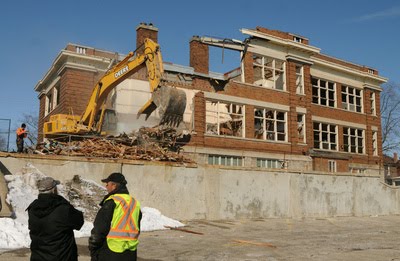
This is a picture from today's Record of a school that was torn down in Cambridge this week:


This is where I live (photo from Google Maps):


...so you can imagine why the loss of the school in Cambridge is very sad for me.

A decade ago, my building was saved by the skin of its teeth. After the original school closed it became an adult learning center, then offices... and then the building was condemned.

Developer Shawky Fahel bought the building and turned it into condos. But unlike almost every other historical condo development in the area, he preserved every aspect of the building that could be saved. He preserved the terrazzo floors in the wide hallways, as well as all the doors, stair railings, the little kid drinking fountains, even the original classrooms (although a couple were divided into two units). The birds-eye maple floors, still marked where desks were bolted to them a hundred years ago, were carefully numbered, pulled up, taken away for refinishing and then replaced. All the plumbing, wiring and heating ducts were replaced, but essentially the building was left its charming old self.

Compare that to the Seagram Lofts: only two walls were saved in each building, and otherwise the "lofts" are all new construction, with no historical materials inside. Or the Bauer Lofts, which is just an apartment building that happens to be built next to the old Bauer factory (which itself was completely gutted, with the only original parts being a little bit of the outside brick).

Further afield, sometimes we "save" heritage buildings in a way that doesn't save them at all. The old Toronto Stock Exchange on Bay Street, for example, was a designated building and so had to be preserved, but all that's left is the facade, swallowed up in a glass skyscraper with no attempt to even riff on the style of the original building. Of the fabulous old art deco interior with its pneumatic tubes and brass, nothing remains.

It would have been best if Uptown Waterloo had maintained enough families that the schools didn't have to close, but given the need for finding something else to do with the historic Alexandra Street School, this is about as good as it gets. (Thanks, Shawky.)

###

Monday, February 07, 2011

Is Waterloo Square in Trouble?

Waterloo Square, lately known as "the Shoppes at Waterloo Town Square," is not flourishing. Nearly half the shops are empty or about to be (the good shoe store and Gizmos are both having closing sales). The remaining clothing stores are not the sort of boutiques that were envisioned as attractions; they're no different from an average mall-type store. The chocolate shop can't be doing well (I never see anyone in there). The "art gallery" and barely-open condo showroom are filler.

What's going wrong?

Some of the retailers believe that business never recovered after the front parking lot was turned into the Public Square. I like the public square and I like the policy to hide parking lots, but it may well be that visible parking attracts shoppers; after all, people flock to malls, where many people walk a long distance across the huge parking lots.

Another problem could be that the mall is just too small. After all, how many malls have barely 20 establishments, including restaurants? But we just spent a pile of money reducing it to a fraction of its previous size (it was not only cut in half, but the tower and basement areas were removed).

Perhaps the stores could be the problem - too expensive and not high enough quality. The vision for Uptown was independently owned boutique stores and gift shops. We haven't had many stores as high quality as Fudge's (which closed due to retirement).

I also wonder if First Gulf, the owner of the mall, isn't setting the rents too high. I wrote a business plan a few years ago for someone who was thinking of renting the coffee shop space, and when I crunched the numbers I saw how difficult it would be to survive with the rent that First Gulf wanted. (They may have lowered it after the space was empty for some time.)

An even more troubling thought is that perhaps Waterloo Square is a bellwether for the Uptown. Uptown has its share of failed or failing stores. Other than Words Worth Books, The Old Goat, Ontario Seed and Lily White, I'm not sure there's anything worth going to Uptown for these days.

Is anyone monitoring the situation, or doing anything about this?

###

Sunday, December 05, 2010

Rallies in the Square: A Suggestion

For anyone planning a rally in the Waterloo public square, I have a suggestion: invite participants to a post-rally event at a local establishment afterwards. Whole Lotta Gelato, Symposium, Jane Bond, the Huether - all would be great spots to meet for post-rally chat. It's good for you: organizers can join in and keep the conversation going. It's good for Uptown: all those establishments could use a boost, especially on a Sunday.

Whole Lotta Gelato, in particular, seems to be struggling a bit these days. They've added lots of new food items: cakes, soup, sandwiches, salads, breakfast stuff (along with their old standbys of paninis, gelato and coffee), and it's an advantage for groups that the upstairs room is often empty. (Plus they have a sort-of all-you-can-eat policy: they won't charge you beyond $13.)

###

Sunday, August 08, 2010

Laurel Trail Interrupted

Laurel Trail runs along Laurel Creek and the railway tracks through Uptown Waterloo, Waterloo Park, and the University of Waterloo. It's a beautiful trail and my bike route to work. Here's a particularly pretty spot:

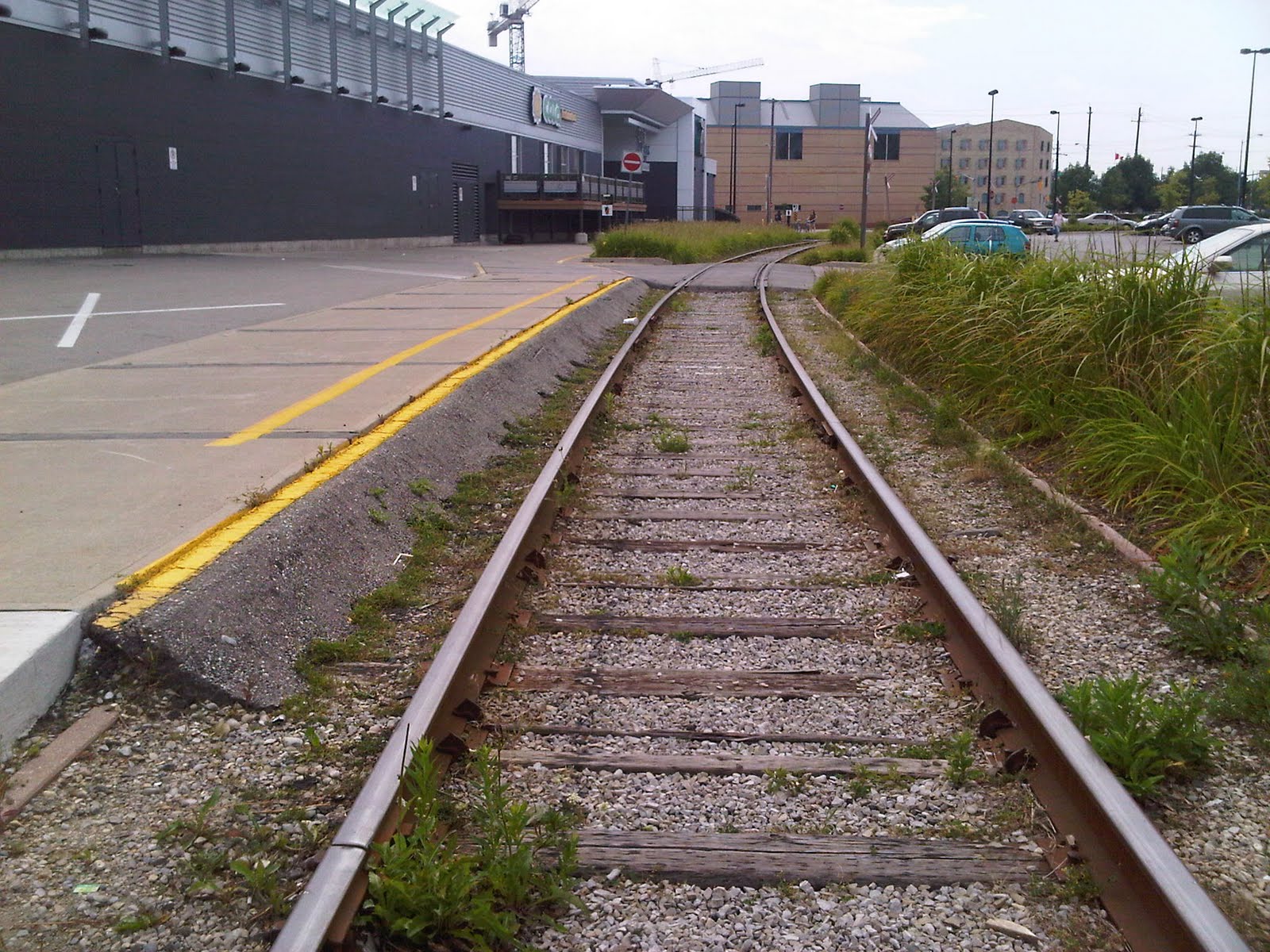
In recent years, the city of Waterloo planted flowers where the trail used to be along the tracks from Caroline to King. From the Waterloo Square north parking lot, here's where the trail used to be, east to King:

...and where the trail used to be, west to Caroline:

I guess City Hall figured that people following the trail can walk on the tracks or in the parking lot. That's a real pain for bicyclists and roller bladers. Also, the break in continuity is a problem for what is already a poorly marked trail.

Laurel Trail should be clearly marked, be paved, and have snow removal - not be a hodgepodge of unmarked segments of path.

The Iron Horse Trail is also abandoned as it goes through Uptown, picking up as it exits each end. Trails should be showcased in Uptown, not abandoned!

###

Saturday, August 07, 2010

Empty Lakes and Concrete Canyons

I snapped this picture of Silver Lake in Waterloo Park yesterday. I was standing on the foot bridge at the western edge of the lake.


In case you're wondering, that dry land is part of the "lake". Water levels in creeks and rivers around the area are fairly high now, even though it's the middle of summer. Not so with Laurel Creek in Waterloo.

A few decades ago, amid concerns that water levels would rise, the city of Waterloo lined creek beds in ghastly-looking blocks of rocks encased in chicken wire. I remember when they did that to Laurel Creek near Marshall, destroying beautiful banks, trees, and plants. You could see the wheel treads of the bulldozers for years. A beautiful burbling brook became a hideous mess.

The park behind Waterloo City Hall got the full treatment: Laurel Creek was buried at the bottom of a concrete canyon:


A block away, just across Erb Street in a less heavily travelled area, Laurel creek is in its natural banks again:


Former mayor Joan McKinnon told me that the water projections of forty years ago turned out to be incorrect, and Laurel Creek has instead dropped in volume. I wonder if there's any way to boost it.

We could have a beautiful (and cooler) uptown if we made the most of Laurel Creek. A hundred years ago Silver Lake was a popular swimming spot; we might not achieve that again, but it could be a pretty place if it had water and maybe even a fountain. Laurel Creek behind City Hall should be naturalized with willow trees hanging over it and rounded grassy banks. It may never be as spectacular as the rushing creek that runs through downtown Boulder, Colorado, but it could be a lovely urban park.

###

Friday, June 18, 2010

Dedicated Bike Lanes

Trendy ideas come and go. We all (myself included) have a tendency to get behind an idea that sounds good, even if we haven't completely thought it through.

The latest fad, in Waterloo Region at least, is bike lanes with curbs around them. These, it is thought, will be safer for bicyclists and so increase bike commuting. Sounds good, no? All of a sudden everyone seems to be behind the idea - you hear it all the time, proposed with great authority.

But wait. There are a few other things to consider:

  • Given the much higher cost of this sort of bike lane over a regular bike lane, a shift to the new lanes will almost certainly slow down the development of new bike lanes.
  • The new bike lanes require more space so won't be possible on many roads. This isn't a drawback unless (as I've heard) people decry the regular bike lane as unsafe - then we just end up with less bike lanes.
  • In winter, it will be more difficult to plough these lanes. Regular bike lanes (essentially just a white stripe down the road marking off a lane for bikes) are easier to plough. The city will have to send out a different sort of snow plough to handle the new bike lanes. They likely just won't get ploughed.
  • As a cylist, I don't relish the idea of a curb surrounding my lane because it makes it more difficult for me to merge with traffic to make a left hand turn or get to an address on the other side of the street. It also makes it more difficult to pass slow bike riders and other impediments.
  • The curb alongside the bike lane does not solve the biggest problem of bike lanes: at intersections, bike lanes tend to disappear - leaving the cyclist high and dry in the most dangerous part of the street. This problem will probably be much worse with curbed bike lanes, as the curb will have to stop at every spot where cars need to turn.
  • Curbed bike lanes only make sense on streets with limited car access - long stretches of road without intersections or driveways. But in those situations, a path running a few meters away from the road is a safer and more enjoyable alternative for bikes.
  • There is an accessibilty consideration: how do pedestrians with walkers, baby buggies or wheelchairs cross them? What about the sight impaired?

The curbed bike lane idea may be made with the best of intentions, but it may also be a very negative force on the future of urban cycling. We'd be better off itemizing the problems with regular bike lanes and thinking up better ways to solve them: motorists parking in bike lanes; lanes running close to parked cars with doors that could suddenly fling open; safe ways for bikes to make turns and cross intersections; etc. And the number one priority is just to have more trails, paths and bike lanes, and to make sure they connect.

###

Friday, April 23, 2010

Bringing Pragmatism to Environmental Issues

Waterloo Region health officials are agitating against a provincial initiative to allow convenience stores to sell wine and beer. Their argument is that it will lead to more drunkenness.

There is no evidence that convenient liquor sales leads to more drinking, and ample evidence to the contrary (in Quebec and the many US states that allow it). However, common sense is all that's needed to see the benefits: less driving. Beer and wine stores are so widely spread in our area that you practically have to own a car to get to them. In all of Waterloo - a town of over 100,000 people in a massive suburban sprawl - there are only three LCBOs and two beer stores.

Having wine and beer in convenience stores will also make corner stores more profitable, which should reverse the trend of declining numbers of corner stores. That will provide even more environmental benefits as residents won't have to rely on a car to pick up milk, the newspaper, and a host of other items.


In our older neighbourhoods you can still see where convenience stores used to be. They are usually on corners, and are often either boarded up or have been converted to a residence. They are reminders of a time when families either shared a car or did without, and were able to buy many necessities on foot.

We're always talking about creating a walkable city. This is how you do it: small, pragmatic steps that consider how people really live.

###