Sunday, August 07, 2011

A Failure of Leadership

I am disappointed that American politicians, pundits and economists, on both the left and right, are condemning Standard & Poor's for lowering the US debt rating. It's like being arrested for a crime that you committed and then calling a press conference to say you're disappointed in the police for arresting you.

There are all kinds of valid criticisms of S&P, but they're moot. Last week, the US government came within hours of defaulting on its debt. That's enough to downgrade its credit rating. Worse, the agreement that broke the impasse in Congress is highly dubious and doesn't bode well for future economic or political well-being of the United States.

There was never any question about the US being unable to pay its debt. This crisis was wholly political and wholly manufactured, and yet very real. Hyperpartisanism and a weak president have made the US a riskier place to invest.

Obama is facing an incredibly difficult situation - an inherited economic crisis, an inherited war, a long-term slide in US fortunes, and an invigorated extremist opposition - so I'm not saying his job is easy, but he just doesn't seem up to it.

So what could the US president have done? Here are a few thoughts...

The 14th amendment, which prescribes the debt ceiling and which was passed in 1868 for very different reasons than exist today, creates a situation that is almost unique in the world: after agreeing to and implementing a budget, the US government has a separate process to agree on the amount of money it can borrow to pay for the budget. The debt ceiling doesn't prevent the government from contracting financial obligations; it prevents it from paying what it owes. It's bad government, and some constitutional scholars believe that the supreme court would overturn it if asked.

After the last midterms Obama should have seen this debt ceiling crisis coming, and taken action in advance. He could have taken steps to get it overturned. He could have taken a page from Dick Cheney's playbook and unilaterally adopted more executive power. He could have paved the way with a PR campaign. He could have bluffed, telling the Republicans that if they didn't agree to a compromise then he'd raise the debt ceiling himself. You might say that the Democrats are hoist on their petard since they voted against raising the debt ceiling in 2006, but that's all the more reason to get out in front of the issue early.

It boggles the mind why the Democrats are continuing to try to be even-handed, compromising negotiators when dealing with the tea party. Obama was reactive throughout the negotiation, and in the end he even praised the agreement that broke the impasse (which gives extraordinary budget-cutting power to 12 members of congress).

US debt could be easily curtailed by (1) rolling back the Bush tax cuts on the rich, which were supposed to expire in 2012, anyway; and (2) reducing the military budget.

Republicans have been able to paint Democrats as reckless spenders, turn the military budget into a sacred cow, and make it nearly impossible to increase taxes. The Democrats could have countered all that. They could have played hard ball. They could have provided better leadership.

It's a good thing that Standard & Poor's downgraded the US credit rating because when a country is that irresponsible and dysfunctional, there should be repercussions. Both parties need a wake-up call. And Americans should be mad as hell. If they had missed the debt ceiling deadline on August 2, it wouldn't just have been bond holders who might have suffered. Medicare, Social Security and unemployment insurance were all on the line, along with the salaries of the military, federal workers, and the rest of the US government's obligations.


###

Monday, June 06, 2011

The Case for Free Transit

Here's my main argument for making transit free. We have to have transit for people who can't drive or can't afford to drive. But currently, transit is worse for the environment than driving, and the reason is that transit vehicles are large, gas guzzling, and frequently nearly empty. This problem isn't specific to Waterloo: studies throughout North America show that when you compare a person taking a trip by transit or a trip in their car, the transit trip costs more, uses more fuel, and produces much more pollution and green house gas emissions. To address this environmental problem, we need to make sure our transit vehicles are fuller. A really effective way to do that would be to stop charging for transit.

Rider fares already cover only a small part of the expense of transit, but the fare is a deterrent to using transit. We need reasonably frequent service, so we can't run less buses. We could run smaller buses - an idea that's been around so long that I can't think why we aren't doing it, unless the drivers' unions have prevented it.

If you argue that transit shouldn't be free, then why is it essentially free for university and college students? They pay a nominal fee folded into their tuition and can't opt out.

Currently, if you own a car and don't live too far from work, then driving to work is cheaper than buying a transit ticket. If you have to have a car anyway, the extra $2.50 a ride or $60 a month for a pass is just an extra expense. But if transit were free, then people who own cars would be more likely to take it anyway. Sure it takes a lot longer and it can be unpleasant when the weather is bad, but they might take it sometimes. And for two car families, the next time they need to replace a car they might realize that they can use transit instead.

It could be the case that if transit were free we'd exceed our capacity. But surely that's a good thing: that's what we want. Our streets could accommodate many, many times more buses than they now do. And in fact, at this point the buses that are busy are mostly carrying high school or post-secondary students, who use different routes (by and large) than commuters.

You might say that people would take trips they otherwise wouldn't, but I doubt that's much of a consideration. When I have a monthly transit pass (which I've had many times in other cities), I haven't gone hog wild tearing around town on transit.

The only other downside I can see is that it would be very expensive - but according to the Region of Waterloo in the recent LRT debates, we would actually save money by doing it. The region claims that when we spend a billion dollars on LRT, we will save more than a billion dollars because we won't need as much road expansion. If the region is telling the truth, then we will save a lot of money by making transit free.

###

Tuesday, May 10, 2011

Spring Floods

As my Aunt Sandra from Memphis said on Sunday, "Always newsworthy is when the river gets to be one mile wide. It is now three miles wide."


Today it is wider.


Back in the days of my great-grandfather, people on each side of the river patrolled the banks at night during floods, and shot dead anyone they saw in a boat - because the easiest way to prevent flooding on your own side was to blow up the levy on the other side.

(There is some speculation that this year's flood might cause the Mississippi to change its course just north of the Louisiana border and align with the Atchafalaya River.)

Sunday, May 08, 2011

The Future of King Street

I spent the weekend in Toronto, and this morning I needed to head cross town in my car. I decided to take St Clair, thinking it would be quicker. Those days are gone...

The recently-completed St. Clair LRT, like other Toronto LRTs, is very different from Waterloo Region's proposed LRT: in Toronto an LRT is a streetcar that stops every two blocks, while in Waterloo the proposed LRT is a train that stops every 1.5 kilometers. But the tracks will be similar. Here's a picture I took on St. Clair today:


The LRT tracks run on a wide, raised platform in the middle of the street. Cars can't cross it, so if they want to access a parking spot, driveway, or even small street on the other side of the LRT tracks, they have to go to the next intersection and make a U-turn. The U-turns require special U-turn lights, and that means that the green lights for going straight are briefer than they would otherwise be. Today on St. Clair it was Sunday and traffic was very light, but it was painfully slow because I got stopped by a red light at every intersection.


In Waterloo region, the long distance between LRT stops means that we'll need buses to run the same route. That will compound the problem - and the current thinking is that we shouldn't have bus bays.

As this snippet of the region's map shows, the LRT prevents left turns at certain intersections, such as John and King. Cars wanting to make a left turn there will have to proceed to the next intersection and make a U-turn.


###

Thursday, April 21, 2011

More concerns about LRT

Four skilled individuals (planning, Engineering, and legal), all of whom live locally, put together this list of comments about the proposed LRT.
  1. K-W is a city of 350,000, not a city of 729,000, the number that is always quoted regarding the Regional population of 2031. The next largest city where a significant LRT investment has been made is three times our current size. In 25 years, based on the cities' potential growth, it will still be two times our size. There is no urgency to get this passed.
  2. The purpose of building the LRT has nothing to do with transit, where there currently simply is no problem. It is to promote reurbanization of the core area.
  3. The outcome regarding the LRT choice has been predetermined by Regional staff from the beginning. The cart has been put before the horse on so many issues related to planning and development prior to a decision being rendered by Council on the LRT. This forces Council with only one alternative and that is to approve.
  4. The public has not been formally engaged in the decision. The conclusions of staff from a few public open houses do not reflect the experiences of a number of the members of Regional Council who are sharing a far different view of the acceptance of the proposal from last fall's municipal election. The only effective way to determine public support is through a referendum.
  5. No one honestly thinks the proposal before Council will come in even remotely close to the current cost estimates. On average, from recent past experience LRT’s built in North America were 40% over budget.
  6. Ridership numbers are fantasy. Currently there are 9,000 riders on the spine, and that is projected to go to 27,000 the day LRT opens and 56,000 by 2031, more than currently use the system in Houston, Baltimore, San Jose, Minneapolis, etc.
  7. The Region is asking the provincial government to amend the current development charge legislation to allow charges to be collected for the LRT. This is a clear sign that there are significant concerns among Regional staff about cost overruns and that the best way to reduce tax impacts is to have available the D/C option.
  8. The Conestoga Parkway is a common argument used in support of the LRT. In the 1960’s many were opposed because “I will never use it.” Looking back, those who built it were visionaries. There are two main differences. First, currently 3% use transit and 98% use cars, likely the same as it was in the 1960’s. Secondly, the Conestoga Parkway was built solely for one purpose, moving people in their cars, which over time it has done. The current LRT proposal has very little to do with dealing with transit needs or moving people. Its primary purpose is for reurbanization. This is a recipe for failure.
  9. The Region claims that the review and approval of the LRT by a 3rd party “Peer Review Panel” validates that this is a sound proposal. Recently the Chair along with several other members of Council have declared a conflict because of a potential benefit received by them or their families if the system gets built. It should be noted that several members of the “3rd Party Peer Review Panel” are also in conflict as they have done work for the Region as consultants, assisting in developing the current policies towards growth and transit. It would be difficult to suggest that the opinion of this group is valid based on the obvious conflict of several of its members by doing work for the Region and by being paid by the Region to do this work.
  10. The Region is backtracking on having the required “feeder” buses in place with the opening of the LRT. In last Friday’s Record it was reported that the LRT cost is putting pressure on the Region being able to provide buses before 2017-2018 - which will significantly limit the ability to get people to the LRT route to use it. This in turn will reduce ridership and directly affect revenues.
  11. The Region is only showing one financial impact summary, and it is based on unrealistically low capital costs ($810M) and overly optimistic ridership targets (27K on opening day). They need to show what the impact will be for every $50M of cost overrun and every 5K of ridership reduction in a matrix which shows a range of potential likely costs. Council and more importantly the public needs to understand the risk prior to any decision being rendered. I asked this question as recently as last week and the answer I received from Thomas Schmidt was that the Region is confident with their budgeting and we need not worry.
  12. The Region has no idea if their proposed routing will in fact be buildable. As recently as a few weeks ago Caroline Street routing was changed from one side of the street to the other because of concerns about access to underground utilities. These kinds of changes have cost impacts and draw concern as to the overall level of detail used to determine budgets to date.
  13. Have the Cities determined that they have sufficient capacity to allow for development in the core areas?
  14. The Region talks about increasing property values along the route as a result of LRT. Higher property values, relative to the basket of values in the overall community, simply means higher taxes for those currently living near the route. So much for a 2% tax increase if your are fortunate enough to have your property go up in value by 20%. How about a 20% tax increase? Generally when property values increase significantly over a short period of time this is referred to as inflation. I am curious as to how this phenomenon, inflation, is view by the Region as being a good thing.

They also have some questions:
  • Has there been a full independent study of the need and justification for the LRT?
  • Will Kitchener, Waterloo and Cambridge really have that much core growth that it will support an LRT??
  • The current proposed route doesn’t connect employment areas to residential areas – how will that be useful??
  • With the Region Planning industrial growth in the Townships (like around the airport and other places) how are these areas going to be connected to the LRT and won’t the time it takes to get to a destination far exceed the time by car??
  • Most of the population will still be far removed from the LRT Route as densities in other areas of the Cities are being planned – how will the LRT be utilized by those people??
  • Isn’t a fixed hard built route a real risk – what if development doesn’t occur the way Region thinks it will – isn’t a rubber tire and perhaps electric battery driven), flexible road based system (which can easily be expanded (or contracted) with dedicated lanes be much cheaper, more flexible and much less risky??
  • What is the breakdown of proposed costs of the LRT? – that is – how much for 1) land acquisition; 2) design and final plan; 3) route preparation (,costs of moving roads, services, etc.); 4) Construction; 5) administration... and are these just estimates?? –
  • Most Region projects end up costing far more than projected. Take the Fairway Road bridge over the Grand: it started at $10M and will now be $50M plus. Won’t the same thing happen to the LRT??
  • What are the annual operating costs? Is there an operations budget? Are shortfalls picked up by the tax payers and what will it add to our tax bills??
  • Where will the projected ridership come from?? Has a fully independent study been performed??
  • What contribution have the feds and province 100% committed to the LRT? Is that commitment still there in light of the upcoming election(s) and what if it changes due to the fiscal constraints?
  • The LRT is focused and predicated on high density along its route – what if this doesn’t materialize because of other building forms, slow growth or alternate transportation systems??
  • The Region has essentially eliminated greenfield growth and attempted to focus high density growth along the LRT. Is our community aware of the implications? – doesn’t this just make K-W another mini Toronto? Is that what we want??
  • Isn’t a much better road network much cheaper than a fixed LRT? Won’t we need the roads anyway for truck routes and general commerce?
  • What are the real costs to putting increased density along the core? New water mains and sewer mains have to replace the old – who is paying for that??

Monday, April 11, 2011

Lack of credibility, the Region, and LRT reports

Chair Jim Wideman and Members of Planning and Works Committee have released the long-awaited LRT report, titled Preliminary Preferred Rapid Transit Implementation Option and dated April 12, 2011.

There is no nice way to say this. The report is another example of flagrantly biased and inaccurate public relations hooey from the Region.

The report says, "In evaluating the rapid transit implementation options and considering the recent public input, staff have identified that: Rapid transit is preferred over business-as-usual." "10 per cent [of respondents] prefer business-as-usual."

This is based on public comment sheets that asked residents to choose one of 11 options, where the only non-rapid transit option was described as "not considered feasible."

I used to work as a market research analyst and I have heard a lot of wild stories about biased surveys, but this one takes the cake.

You do a survey in which you instruct people not to choose one of the options, and then you claim the survey proves that they don't want that option.

###

The Region's LRT ridership estimates: pie in the sky


The figures for other cities are from Wikipedia.

This analysis was done by Dave Ramsey. Dave's conclusions:
  1. The estimated daily boardings of 56,000 in 2031 are overstated by at least 40,000.
  2. Just like every city in North America with a population of less than 1M, KW will not need the LRT or BRT to cope with its public transit needs now or when the population reaches 462,000 in 2031.
  3. If LRT is installed, the numbers show it will be a financial disaster. With 15,000 daily boardings rather than the estimated 57,000, subsidies will skyrocket over those forecast. In 2002, after 24 years Edmonton’s LRT had 36,000 boardings with an annual subsidy of $13.7M (see “ETS Light Rail Transit” bulletin). With less than half the boarders, the region’s subsidy will be about $21.7M instead of the $3.8M forecast (see ‘Connecting to the Future’ Summer 2009).

The myth of the successful Calgary LRT

The 30th Anniversary of the C-Train: A Critical Analysis of Calgary’s Light Rail Transit System, by Steve Lafleur

Some nuggets about the Calgary LRT (dubbed the CTrain) from this report, which was released on March 30, 2011:
  • The conservative estimate herein puts the cost per paying rider at roughly $2.88
  • [There is an assumption] that the CTrain is actually getting people out of their cars — it is not. Despite the City’s Draconian efforts to curb downtown parking, more people drive downtown than in any other Canadian city.
  • Calgarians travel further to work than do residents of any Canadian city with a population over one million, save Edmonton.
  • the CTrain has actually helped drive urban sprawl
  • The independent U.S. Government Accountbility Office recognizes BRT as a superior alternative to LRT.
  • It is slow and expensive and at best has a moderately positive impact on traffic. At worst, it has a moderately negative impact.

###

Saturday, April 09, 2011

Negative impact of LRT on the City of Waterloo

I wrote a little report on some concerns I have about what LRT will do to the city of Waterloo. You can download it here. (Click the file name LRT_impact_on_Waterloo.pdf at the top.)

Upate: I expanded the report so that the Waterloo city impacts are just part of it.

###

Support for light rail trains gets a boost

During the recent public consultations, the Region distributed a survey that could be filled out on paper or online. It listed 11 options: nine were forms of LRT, one was BRT on dedicated lanes, and one was no rapid transit.

The Region has released the results of the survey, causing the Record to trumpet that 78% of respondents voted for rapid transit, proving that the public wants LRT. But let's look at the survey.

The only option that was not rapid transit was phrased like this in the survey:

"BU11 - Business as usual - no rapid transit (not considered feasible, especially because of its quality of life impacts, disruptive road expansion and because it does not align with the Council-approved Regional Official Plan and Regional Transportation Master Plan)."

Who ever heard of a survey that describes one of the options as "not feasible"? This wording is so slanted that the survey is utterly worthless.

That "not feasible" option is not only feasible; it is clearly the best. It is the option that includes aBRT.

aBRT, or adapted bus rapid transit, is a much cheaper option that BRT in that it doesn't require dedicated lanes for the entirety of the route. It does employ signal priority, queue jumping, and bus-bypassing shoulders, so it is approximately the same speed as BRT (and it's quicker than LRT for the whole route because riders don't have to transfer in the middle). It is much more flexible than LRT or BRT in that the route can easily be changed. It is also much more flexible in that it can be converted to rail in future at little cost if the ridership rises. (BRT, with fixed curbs along the whole route, is very expensive to convert to rail.)

Not only does aBRT make sense, but it is the option currently preferred by Cambridge City Council.

Other questions abound about the survey.

It appears that the Region has counted only the printed surveys, and has ignored the online submissions. The only explanation I can think of for this is that the online surveys must have been against LRT.

The Record article trumpeting the survey results pulls out all stops in slanted reporting. (Support for light rail trains gets a boost) The reporter interviewed me yesterday and I explained the problems with the survye, but he neglected to report them. The article gives the erroneous impression that high tech emloyees are clamoring for LRT, which is utter hogwash. And while the pro-LRT organization is named in full, T4ST is not mentioned. To add insult to injury, they spelled my name wrong. I am referred to as "Ruth Howarth, the spokesperson for a group opposed to the light-rail plans."

###

Friday, April 08, 2011

The sheep freak out

There seems to be tacit agreement among governments and media that the public must not be panicked by the Japan nuclear reactor fallout. Every step of the way we have been told that certain things can't happen... and then they do.

So we were told this wasn't Chernobyl and it wouldn't be possible to have nuclear contamination outside the reactors... and then when that happened they said it wouldn't spread... and then when that happened they said it wouldn't be harmful... and then when that happened they said it wouldn't get to North America... and now nuclear fallout has been detected (in small quantities) at the Bruce Power plant on the shores of Lake Huron. And just to be clear about this, that's really close to where I live.

I understand the rationale for this "benevolent conspiracy." Nobody wants boatloads of Japanese refugees foundering in the middle of the Pacific. Nobody wants a worldwide financial collapse caused by panic and fear.

But. I for one am starting to freak out only because of all the lies. What else aren't they telling us?

###

World of debt

In last month's "State of the City" address, Waterloo Mayor Brenda Halloran said that "finances remain the city's biggest challenge, with a $5-million dollar debt over RIM Park still to pay off", according to local news sources.

Not long ago, five million dollars seemed like an awful lot of money... after all, that $5M debt has restricted city spending across the board for many years and it will restrict spending for many years to come. Sports, arts, community programs, children's programs, parks... everything has taken a hit because of that RIM Park debt.

But now that LRT is on the table, a $5M debt is laughable. When the Region builds a rail route through Waterloo, the city of Waterloo is going to have to pay many times more than $5M just for downloaded capital costs. The Region expects the municipalities to pony up for:
  • Building parking garages next to LRT stations
  • Resurfacing roads torn up by LRT construction
  • Moving hydro vaults, utility poles, lamp posts, fire plugs as needed for LRT
  • Rebuilding curbs and sidewalks torn up by LRT
  • And who knows what else...

But wait, there's more! Cambridge Mayor Doug Craig has estimated that LRT will cost $23M per year in operating costs, all of which will be paid by regional taxpayers. Yes, that's right: that crippling RIM Park debt that it's taking Waterloo decades to pay off - Waterloo taxpayers' portion of LRT operating costs will be more than that every year... forever!

All that is in addition to increased regional taxes to pay the roughly $500M that will be the Region's portion of LRT construction costs.

Then there's the rest of the region's Master Transportation Plan, which staff estimate will cost $3.75B (yes, that's billion) over 20 years.

When I write about LRT, I tend to focus on problems with the route, inconvenience, inaccurate ridership projections, inability to meet stated goals, and things along those lines.

But cost is also a vital element of all this.

Here's one scenario that's looking pretty realistic about now: Taxes are going to rise so much in Waterloo, Kitchener and Cambridge that, far from creating flourishing downtown cores, LRT will cause masses of people to move out to the townships (which won't pay into LRT and so will have much lower taxes) and commute long distances on area highways.

Having LRT tracks running through our commercial corridor, combined with the need to run buses on the same routes because LRT stops so infrequently, will result in so much congestion that everyone will avoid the core like the plague.

The LRT won't be empty though; it will be full of University of Waterloo students who use it as a student shuttle to zip past the empty storefronts.

###

Thursday, April 07, 2011

Questions about rail plan go beyond money

My article in the Record today:

Questions about rail plan go beyond money

In his April 1 community editorial board article, We’re More than a Collection of Taxpayers, Sean Geobey dismisses the community’s objections to light rail transit as a cynical knee-jerk reaction by people who don’t understand what community is all about. He claims all we care about is lower taxes.

Never mind that as the representative for Taxpayers for Sensible Transit (T4ST), I have written articles in this paper that express support for improved transit and detail why light rail is the wrong approach. Or that Taxpayers for Sensible Transit has made official submissions to regional council expressing our concerns about the effect of light rail on our transit system and community.

Never mind that this paper has published nearly 200 letters to the editor against light rail (all reproduced on www.t4st.com) that are proof of residents’ keen commitment to our community and deep understanding of the issues.

Had Geobey done any research into why so many citizens oppose light rail, he would have seen that this issue is about much more than cost.

Consider the devastating impact the tracks will have on Uptown Waterloo. Of all the downtowns in our region, Waterloo’s is clearly the most vibrant and functional. But the imposition of light rail on King Street and other Uptown streets will make driving chaotic, discourage shoppers and inevitably rob the area of its vitality.

Trains will run against traffic on the one-way portion of Erb Street at Albert Street. This is not only inconvenient, but also dangerous. The Erb/Bridgeport/Caroline intersection will come to a halt every 3.5 minutes for trains to cross. As a result, Erb Street will cease to be a useful east-west route. And it will be impossible to hold popular tourist events such as the Busker Festival on King Street.

More problems: Waterloo Park will be sliced in two by trains. It seems likely a fence will be required, especially since the tracks border a children’s zoo. This will leave the park looking like postwar Berlin.

As a replacement for the iXpress bus, light rail will provide service that is much less convenient. For example, the iXpress stops in the centre of the research and technology park and close to the entrances of Conestoga Mall and Fairview Mall; the light rail transit trains would stop much farther away, requiring long walks for transit riders.

Why is convenience so important? Because you won’t lure people out of their cars with inconvenient public transit.

The cost model of light rail transit assumes that we can afford to spend hundreds of millions of dollars on a rail line because it will result in less money needed for road expansion. If light rail transit does not lure drivers out of their cars, then we are stuck with the unaffordable situation of paying for light rail transit and paying for road expansion.

Light rail transit is a great deal for students at the University of Waterloo, and that no doubt is why Geobey and other students are such vocal supporters. Every student gets a transit pass included in their fees (at a greatly reduced rate). Students are a major component of our transit ridership, and it is important to provide service for them. But we do not need to provide a $1-billion train so that they can live further from campus.

My point here is not to repeat every argument against light rail transit. It is important to lift the public dialogue on light rail transit out of the mindset of Geobey and some other light rail supporters who characterize the anti-rail side as backward-thinking old-timers who don’t know what’s good for the community.

The Region of Waterloo is voting on light rail in June, so we don’t have a lot of time to think through the effects of this megaproject — both financial and physical — on our community. Let’s keep the dialogue respectful.

Ruth Haworth is the spokesperson for Taxpayers for Sensible Transit. She writes the transit web site http://www.t4st.com.

###

Sunday, April 03, 2011

Hyperdecantenation

The enitrety of info about hyperdecantenation in Incredible edibles, a recent article about molecular gastronomy in the New Yorker:
They also claim to have a way of improving wine by “hyperdecanting” it via sixty seconds in a blender—the idea being that it will benefit from the oxygenation and outgassing effects. My solemn, taking-one-for-the-team experiments with red wine have partly confirmed this for Schwarzeneggerian young reds.

I took up the gauntlet. First stop, the liquor store, where I pulled a little prank on the vintages clerk when I put on a serious face and asked for help locating a young Schwarzeneggerian red. (I imagine he's still talking about it.)

Came home with a bottle purported to be a big young Californian red: the 2008 Liberty Cab ($17), and just for fun, the cheapest Italian red I could find (year unknown, name forgotten, bottle recycled). Invited over two wine-loving friends.

Put out three glasses at each place: one for the wine straight out of the bottle, one for the hyperdecanted wine, and my Eisch "breathable" wine glasses, which I have confirmed in other wine tastings do amazing things to wine.

I hyperdecanted by blenderizing each wine for 60 seconds, starting with the Liberty.

The effect was pronounced. Right out of the bottle, the Liberty tasted stellar: rounded, layered. The hyperdecanted Liberty was good, but lost a lot of its definition. It became much more generic tasting, mellow, a bit blah. The Eisch was right in the middle: it was superb.

Some quick palate cleansing and then it was on to the Italian. (No rest for the weary.) Out of the bottle it was harsh, raw, and a bit hard to drink. (Ordinarily I'd have added a teaspoon of water to my glass to mellow it out.) The Eisch was better but still harsh. The hyperdecanted, though: oh, my. It was a transformed wine: the harshness gone.

By the way, the foaminess recedes almost immediately. The hyperdecantenation seemed to remove the "legs" from the Liberty, but added some to the Italian: I don't know if that makes any sense.

Moral of the story? Buy cheap wine and put it in the blender.

###

Friday, March 25, 2011

Unknown Costs of LRT

We don’t yet know the Region’s preferred option for LRT, so we don’t have final estimates of capital costs or the increases to property taxes. But we know it will result in hundreds of millions in costs to Regional taxpayers.

Recently, it has become apparent that there may be more costs that haven't been made public so far, and that there are other issues around costs that are much too unclear. In particular:
  • Downloading – At a March 11, 2011 meeting of municipal Directors of Engineering, it supposedly came out that the Region intends for the municipalities to pay for a portion of capital costs related to LRT. These are costs related to moving hydro vaults and poles, resurfacing roads, rebuilding curbs and sidewalks, moving light posts, and so on. I have confirmed this information with two senior sources, but don’t know if it is completely settled yet.

  • Tax increases – A recent article in the Waterloo Chronicle revealed that property tax increases that have been publicized have been a bit misleading. The increases are cumulative, so a $20 increase means $40 the second year, $60 the third year, and so on. See Confusion over tax impact of rapid transit, March 15.

  • Land acquisition costs – Some local politicians have raised concerns about land acquisition costs, which could be much higher than expected because the Region will have to acquire a lot of land at one time. I have heard this issue described as "the big cloud hanging over LRT."

  • Costs of alternatives not known – The Cambridge Economic Development Advisory Committee has advised Cambridge City Council that rapid transit should not proceed until comparison costs for aBRT are known. In the Region’s February 15 eleven-option report, the only bus option was a “Cadillac” version of BRT that went to St Jacob’s market. We need to be able to compare realistic options: LRT, BRT, aBRT/expanded iXpress. (Note: aBRT is like BRT but merges in with regular traffic most of the time.)

  • Total transit costs not known – LRT is part of a transit solution that includes a lot of other transit enhancements. The cost of the Transportation Master Plan over 20 years is estimated to be $3.75B, according to Regional staff. It is disingenuous at best to tell us the tax effect of LRT without telling us the tax effect of the total transit solution.

  • The effect of cost overruns – A couple of years into construction, what will the Region do if there are large cost overruns? Will it ask the townships to pitch in? Will it ask the municipalities to kick in more? If all of the overrun is paid for by the regional tax base, how much might regional taxes rise?

We need objective analysis of all these issues – not more PR.

LRT should be deferred until all these cost issues are resolved.
###

Friday, March 18, 2011

Downloading LRT Capital Costs

I have heard that the Regional LRT plan includes a lot of downloaded costs to the municipalities where LRT goes - Waterloo and Kitchener. Apparently this came out at a recent meeting of Regional Council. It was one of those situations where staff made a presentation and councillors, realizing that something wasn't adding up, probed until some unexpected truths came out. Or so I hear.

If true, then Kitchener and Waterloo city councils are going to have to come up with tens of millions of dollars to pay to repair the infrastructure damaged by LRT construction: moving hydro polls and lamp posts, replacing curbs and sidewalks, repaving torn-up sections of road.

Just to be clear: this is a bombshell. If true, it means that severely strained municipal budgets will be stretched past the limit.

In addition, there is a second possible set of costs to the municipalities (and this might affect Cambridge as well): What will the Region do if there are cost overruns? The provincial and regional governments have agreed to pay 2/3 the cost of LRT to a limit. We pay the other third of the budgeted cost and we pay all cost overruns. If LRT goes a few hundred million dollars over-budget (which is not uncommon), where will the region get the extra money from? Will they guarantee that they won't demand more from lower tier governments?

When people talk of the cost of LRT, they mostly talk about tax increases. It goes beyond that. It also means cuts to lots of other municipal services: the libraries, arts funding, parks maintenance, road repair, snow removal, on and on and on. We in Waterloo are already cut to the bone because of RIM Park.

I'm throwing this out there, and if anyone has evidence one way or the other, I'd like to hear it. It is not responsible to proceed with LRT if there are any uncertainties of this magnitude.

Update: I have received confirmation that this downloading of capital costs is indeed the plan. And there's more - apparently the region also intends for Kitchener and Waterloo to build parking garages for some of the stations.

###

Thursday, March 17, 2011

Cambridge: Getting Screwed and Dodging a Bullet

On her blog, Regional councillor Jane Mitchell completely poo-poos any concerns of Cambridge residents that LRT won't extend to their city. She describes Cambridge as a bunch of whiners who had terrible transit when it was their responsibility, who don't have the ridership to justify being in on Phase 1 of the LRT, and who make a habit of complaining falsely of unfair treatment by the Region.

I was embarrassed by the post and thought it was shockingly undiplomatic, especially as it was written by someone who's making decisions for the entire region. But in addition, it's wrong. This is not about being unkind to Cambridge; it's about materially disadvantaging them.

First - The LRT is not going to be much faster than the iXpress in travelling from Conestoga Mall to Fairview Mall. But for people going on to Cambridge, the LRT requires that people get off the train and wait for a bus - which means that for people going from Cambridge to anywhere in K-W, the trip will be slower and less convenient than iXpress. They are expected to contribute over a hundred million dollars - possibly several hundred million with expected cost overruns - for a transit system that is worse than what they have now.

Second - Imagine five years from now, when a company or individual is considering relocating to Waterloo Region. What signal do they get from the region's second-largest city not being on the main transit route? This isn't just about disadvantaging transit riders: it's about disadvantaging Cambridge real estate and property values and businesses. An LRT that doesn't go to Cambridge is far worse for Cambridge than no LRT at all.

In my research I have been talking to Cambridge residents, politicians and city staff, and what I hear is that they are well aware that they both have been screwed and dodged a bullet. Screwed in the ways I mention above, but dodged a bullet in other important ways. LRT would have messed up Water Street and the lovely, growing core of Galt. In addition, it looks like the municipalities are going to have to foot the bill for a lot of LRT capital costs: for replacing pavement, sidewalks and curbs that are torn up; for moving hydro polls and street lights; and so on. This was wholly unknown until Nancy Button was asked a question about it at the last Regional Council meeting. This could be tens of millions for each of Waterloo and Kitchener: I heard that Cambridge recently had to pay $2M for such capital costs when the Region built a roundabout.

Note: I like Jane Mitchell's blog a lot. I read it regularly, and I think she does us a service by being so candid in her writing. I wish I'd written a positive post about it before writing this negative one.

###

Turmoil in the Middle East

This is just a sidebar, or metacomment, to the coverage of upheaval in the middle east.

I don't trust the coverage we're getting, because behind it I see a smirk - both from the people in the news rooms, and from our western governments.

Since September 11, 2001 - and before - the west has seen the Muslim states as their enemy, at least partially. Now that there are several popular upheavals against governments in those states, there seems to be a bit of smugness in our reaction. Oh, we genuinely care about the plight of people there: but we are also glad to see the comeuppance of these governments that formed oil cartels and stood against us and had the economic power to oppose our governments' worldview.

This reaction seems to be slanting our view of what's going on. I don't view the protests as primarily about democracy. I think it's more a matter of demographics.

Years ago, I heard a lecture by a demographer who said that in coming years (about now), the proportion of 18 to 25 year-olds in Arab states would result in social upheaval. He said that the proportion of young adults would be so high that they would face massive unemployment, and that historically that led to violence - and he said the only way to avoid it was to give them an outlet through emigration.

We don't hear anything like that in our current coverage. It's all about the dream of democracy. But what democracy? Toppling a dictator does not guarantee democracy. More likely it results in another dictator.

A few other thoughts:
  • Fair elections cost a lot: $200 million and up. Can all these countries afford them? Is democracy sustainable?
  • As Hannah Arendt argued, the political/economic system adopted by a country is only part of the picture: culture is the major factor. Changing the way the government is chosen is not always as much a game-changer as we assume.
  • How much of all this is due to problems of countries whose economies are developing on the back of oil production? There are all sorts of things at play: a dominant industry that provides relatively little employment; the interference of oil-consuming nations; the ownership of the industry by giant multinationals; the potential for corruption; etc etc.

Saturday, March 05, 2011

Rail transit will not solve urban congestion

I have another guest column in the Record today: Public will never give up their cars. It is printed along with an article by Tim Mollison of Tri-Tag: Rail transit an answer to urban congestion.

While I thank the Record for airing the debate, I'm not thrilled with the way they broke up my paragraphs in the print edition, which messed it up somewhat (the online version is the way I wrote it). Also, I object to the headline they put on my piece, as I neither say nor intend to say that the public will never give up their cars. I myself bought my first car at 40 and would prefer not to own one. A better headline for my piece would have been "Rail transit will not solve urban congestion."

However, reading my column again, it would have been better to put the last four paragraphs first, which would have clarified where I stand on transit. I want better transit; I want density; and I want a city that makes it easy to get around on transit - but from my analysis of the proposal, I think LRT will not only fail at achieving those goals, but will take us backwards.

Anyway, that's not the point of this post. If anyone is interested in the Jane Jacobs reference, I thought I'd supply it. She has a lot more to say about why LRT became a fad and why it's wrong. Luckily, parts of the book are available on Google books, here.

Here is the relevant excerpt:
[Paul Martin] told me that he intended to announce a program of federal grants enabling municipalities to install light-rail public transit. Now it was my turn to demur.

I told him that unfortunate experiences already showed that fixed transit routes were expensive failures when they were not preceded by evidence of sufficient demand. Underused routes not only are a drain on transit systems but are ill-suited as contributors to the needs and convenience of users. In the past, designers of transit systems had usually chosen to locate rail routes by observing which bus routes were most heavily used, a pragmatic method that worked well in Toronto and elsewhere. After it was apparently lost to transit engineers' memories in the 1960's, Toronto and a number of other cities, among them Atlanta, Buffalo, Detroit, and Chicago, tried rail routes justified by other goals and these have been unable to pull their weights, literally or figuratively. They don't have enough passengers.

I asserted that a prudent program to promote transit must be flexible enough to encourage experiments with routes, should that be what a city wanted to do, and possibly experiment with bus sizes, before settling on fixed rail routes. Why not specify grants for transit? I wondered aloud. Why specify from on high what form the transit must take?

... [Mr. Martin] pointed out that the mayors of every large city had asked for light-rail transit grants. I told him that I had attended the meetings where they arrived at this unanimity; they reasoned that asking for light-rail grants was politically more realistic than asking for other kinds of public transit equipment or more general transit help, such as grants for operating costs, the most desperate need in some municipalities.

Mr. Martin perfunctorily conceded that flexibility might be worth taking into consideration. Again I saw that our points of view were different. What he could contemplate as attractive bonanzas for clamoring cities and perhaps for complaining corporations producing rails and streetcars, I feared as foregone fiascoes.

###

Thursday, February 24, 2011

Heritage, Sense of Place, Identity, Culture

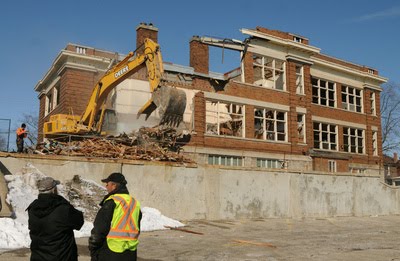
This is a picture from today's Record of a school that was torn down in Cambridge this week:


This is where I live (photo from Google Maps):


...so you can imagine why the loss of the school in Cambridge is very sad for me.

A decade ago, my building was saved by the skin of its teeth. After the original school closed it became an adult learning center, then offices... and then the building was condemned.

Developer Shawky Fahel bought the building and turned it into condos. But unlike almost every other historical condo development in the area, he preserved every aspect of the building that could be saved. He preserved the terrazzo floors in the wide hallways, as well as all the doors, stair railings, the little kid drinking fountains, even the original classrooms (although a couple were divided into two units). The birds-eye maple floors, still marked where desks were bolted to them a hundred years ago, were carefully numbered, pulled up, taken away for refinishing and then replaced. All the plumbing, wiring and heating ducts were replaced, but essentially the building was left its charming old self.

Compare that to the Seagram Lofts: only two walls were saved in each building, and otherwise the "lofts" are all new construction, with no historical materials inside. Or the Bauer Lofts, which is just an apartment building that happens to be built next to the old Bauer factory (which itself was completely gutted, with the only original parts being a little bit of the outside brick).

Further afield, sometimes we "save" heritage buildings in a way that doesn't save them at all. The old Toronto Stock Exchange on Bay Street, for example, was a designated building and so had to be preserved, but all that's left is the facade, swallowed up in a glass skyscraper with no attempt to even riff on the style of the original building. Of the fabulous old art deco interior with its pneumatic tubes and brass, nothing remains.

It would have been best if Uptown Waterloo had maintained enough families that the schools didn't have to close, but given the need for finding something else to do with the historic Alexandra Street School, this is about as good as it gets. (Thanks, Shawky.)

###