Rush hour traffic in uptown Waterloo is a mess. Some of the busiest intersections - William/Caroline, Erb/Caroline - are going to get even worse when the LRT goes through them.
What we need to relieve the congestion in uptown is an expressway, or at least a rapid road, on the west side of town. Currently the Conestoga Parkway (shown in yellow below) is only two-thirds of a ring road.
In recent years much of our growth has been in the north-west, an area not serviced by the Conestoga Parkway. People in those subdivisions clog up Erb and University getting to the parkway, and a lot of them drive across the uptown getting there.
As more and more condos are built in the uptown, too much of that commuter traffic is heading east, putting pressure on Park, William, Caroline, and other streets that feed onto the Conestoga Parkway. If more of that traffic could be funnelled west, much pressure would be relieved.
A few years ago it was widely believed that Ira Needles Boulevard would be the west side rapid road, but then it was lined with dozens of big box stores and it can barely support local traffic. Our options are more limited now, but there has to be a solution.
Monday, February 03, 2014
Child abuse
Imagine if you will a 7 year old girl who said that the male adult in her home had molested her; the police were called and said that while they found substance to the allegation, they thought the girl was too fragile to be a witness in a prosecution, and so declined to prosecute. Now imagine that 22 years later she repeated her allegations. Take away the celebrity parents. How would you want our society to react?
I hope that you would want them to support the girl. But nobody in the press seems to want to support Dylan Previn (or whatever her name is now). Article after article, including by respectable writers in the Globe and Mail, are trashing her. As Kate Taylor wrote today, "the man has a right to be tried in a court of law not the court of Twitter."
This issue is important because of the people who are watching it play out: the abuse victims who are afraid to speak up, the abusers who are getting away with it, the potential abusers who are reckoning whether they can get away with it, the witnesses who are trying to decide if they should risk speaking up. This isn't about celebrities; it's about children who are being heinously harmed.
I hope that you would want them to support the girl. But nobody in the press seems to want to support Dylan Previn (or whatever her name is now). Article after article, including by respectable writers in the Globe and Mail, are trashing her. As Kate Taylor wrote today, "the man has a right to be tried in a court of law not the court of Twitter."
This issue is important because of the people who are watching it play out: the abuse victims who are afraid to speak up, the abusers who are getting away with it, the potential abusers who are reckoning whether they can get away with it, the witnesses who are trying to decide if they should risk speaking up. This isn't about celebrities; it's about children who are being heinously harmed.
Monday, November 11, 2013
The attack on peace
Twice this weekend I heard the local Talk Radio station lead their news broadcast with these words: "A handful of university students have hopped aboard the left-wing Rideau Institute's "white poppy" bandwagon for Remembrance Day, promoting their pacifist ideology by piggybacking on the Royal Canadian Legion's red poppy campaign."
I googled part of the quote and discovered that the entire news story was lifted from an article in the Toronto Sun (link). The Sun article, of course, includes additional invective and links to other stories about outrage towards the white poppy campaign.
So, first off, shame on me for listening to a radio station that takes its newscasts verbatim from the gutter press, but there's more to this. We first noticed this trend in the US, where any objection to war was deemed to be disrespect to members of the armed forces (even though the situation is exactly the opposite). Now in Canada people can't take a slightly different view of Remembrance Day without being viciously attacked.
There is something seriously, seriously wrong here.
I googled part of the quote and discovered that the entire news story was lifted from an article in the Toronto Sun (link). The Sun article, of course, includes additional invective and links to other stories about outrage towards the white poppy campaign.
So, first off, shame on me for listening to a radio station that takes its newscasts verbatim from the gutter press, but there's more to this. We first noticed this trend in the US, where any objection to war was deemed to be disrespect to members of the armed forces (even though the situation is exactly the opposite). Now in Canada people can't take a slightly different view of Remembrance Day without being viciously attacked.
There is something seriously, seriously wrong here.
Saturday, November 09, 2013
King & University: Density node? Neighborhood? Mess?
The density at King & University has been a long time coming. When I was a teenager in the 70s there were already large apartment buildings on Regina Street North. University Avenue in the King-Regina area has been steadily growing with apartments and strip malls. WLU is building more and more student residences in the area.
We now have one of the densest parts of the region (perhaps the densest in Waterloo) located at King & University, and it's difficult to see any coordination or planning whatsoever. It's the node that Waterloo City Hall forgot.
The intersection at King & University is one of the most dangerous in the Region. In 2012 there were 41,000 vehicles and 6,000 pedestrians using the intersection each day, and there were 130 collisions, including 11 involving pedestrians. (link) City Council recently debated installing a pedestrian scramble there but decided not to, apparently because it would cause even greater traffic delays.
Both King and University are major routes for drivers going cross town. The intersection is a bottleneck, largely because of the lack of a right turn lane for traffic heading south on King turning west on University. Traffic backs up because those right-turners have to wait for all the pedestrians to clear the crosswalk.
It's a real problem that such a dense neighborhood lacks a grocery store. The area was recently reduced to just one corner store when Forwells threw in the towel. And there are other amenities that should be apportioned to neighborhoods, such as a park. For the student population, you'd think a beer store would be appreciated. For non-students, some sort of sports field or playground might be useful.
There are some student eateries in the area (notably Frat Burger, Burrito Boyz, Morty's, and a Starbucks), but the retail shopping is not aimed at the local population or pedestrians in general. There is an automotive repair place, a store that sells 20-liter bottles of water, specialty medical buildings.
For pedestrians, the area is inconvenient and unpleasant. The sidewalks abut against the street. The strip malls have large parking lots out front. The stores are widely spaced. And then there's that dangerous intersection, which is no fun at all to cross.
The City of Waterloo can't help that the Region decided to make the LRT bypass King & University: the Region was bound and determined to route the LRT through the UW campus so that its ridership numbers will be bolstered by students with free transit passes. But the city has to do something to improve the King & University neighborhood. For starters, it needs a name. Next, it needs a vision. Then it needs a plan.
Maybe we need to restrict cars from turning off of King and/or University. Add pedestrian islands in the crosswalks. The area could use a streetscape improvement plan with better sidewalks, planters, trees, and benches. A beer store could perhaps anchor a development with a grocer's. It's all going to be time consuming and expensive, but it's too important an area to overlook any longer. Just consider how much time and money Waterloo has spent on Claire Lake (a pond in a wealthy subdivision) or the Clay & Glass Museum (which practically nobody goes to except school children who have no choice).
And almost more important than anything else, if we built a proper hiway on the west side of Waterloo, we could hugely reduce the traffic that floods down University and Erb to the Conestoga Parkway - a hiway that connects major arteries like the 401 with the east side of town.
Before any decisions are made, we need a solid understanding of the neighborhood now and in the future. Think you know everything? This is being built just a couple of blocks away:
Update, January 10, 2014:
I drove down King from Columbia to William last Thursday around 10 PM. In the area from Hickory to Lodge there were masses of people on the snowy sidewalks. The uptown had less than half as many people, even including those at the skating rink in Waterloo Square.
We now have one of the densest parts of the region (perhaps the densest in Waterloo) located at King & University, and it's difficult to see any coordination or planning whatsoever. It's the node that Waterloo City Hall forgot.
The intersection at King & University is one of the most dangerous in the Region. In 2012 there were 41,000 vehicles and 6,000 pedestrians using the intersection each day, and there were 130 collisions, including 11 involving pedestrians. (link) City Council recently debated installing a pedestrian scramble there but decided not to, apparently because it would cause even greater traffic delays.
Both King and University are major routes for drivers going cross town. The intersection is a bottleneck, largely because of the lack of a right turn lane for traffic heading south on King turning west on University. Traffic backs up because those right-turners have to wait for all the pedestrians to clear the crosswalk.
It's a real problem that such a dense neighborhood lacks a grocery store. The area was recently reduced to just one corner store when Forwells threw in the towel. And there are other amenities that should be apportioned to neighborhoods, such as a park. For the student population, you'd think a beer store would be appreciated. For non-students, some sort of sports field or playground might be useful.
There are some student eateries in the area (notably Frat Burger, Burrito Boyz, Morty's, and a Starbucks), but the retail shopping is not aimed at the local population or pedestrians in general. There is an automotive repair place, a store that sells 20-liter bottles of water, specialty medical buildings.
For pedestrians, the area is inconvenient and unpleasant. The sidewalks abut against the street. The strip malls have large parking lots out front. The stores are widely spaced. And then there's that dangerous intersection, which is no fun at all to cross.
The City of Waterloo can't help that the Region decided to make the LRT bypass King & University: the Region was bound and determined to route the LRT through the UW campus so that its ridership numbers will be bolstered by students with free transit passes. But the city has to do something to improve the King & University neighborhood. For starters, it needs a name. Next, it needs a vision. Then it needs a plan.
Maybe we need to restrict cars from turning off of King and/or University. Add pedestrian islands in the crosswalks. The area could use a streetscape improvement plan with better sidewalks, planters, trees, and benches. A beer store could perhaps anchor a development with a grocer's. It's all going to be time consuming and expensive, but it's too important an area to overlook any longer. Just consider how much time and money Waterloo has spent on Claire Lake (a pond in a wealthy subdivision) or the Clay & Glass Museum (which practically nobody goes to except school children who have no choice).
And almost more important than anything else, if we built a proper hiway on the west side of Waterloo, we could hugely reduce the traffic that floods down University and Erb to the Conestoga Parkway - a hiway that connects major arteries like the 401 with the east side of town.
Before any decisions are made, we need a solid understanding of the neighborhood now and in the future. Think you know everything? This is being built just a couple of blocks away:
Update, January 10, 2014:
I drove down King from Columbia to William last Thursday around 10 PM. In the area from Hickory to Lodge there were masses of people on the snowy sidewalks. The uptown had less than half as many people, even including those at the skating rink in Waterloo Square.
Cell phones > Smartphones > Superphones > ?
Just fooling around here, but with the rapid evolution of smartphone technology, you have to be wondering where it's going.Earlier this year we learned of an imager chip that lets mobile phones see through walls, clothes, and other objects.
With Square, we see an evolution to peripheral devices that free consumers from the sales cycle of phone manufacturers. (Square sells a little piece of hardware that turns phones into credit card readers.)
And of course, wearable phones are here, currently as glasses or watches.
But we still seem to be just on the cusp of fundamental change. There is emerging technology that lets finger and hand gestures do many things, that lets brain power direct objects without physical intervention, that replaces phone screens with public viewing areas. In five years the paradigm of typing on tiny keyboards and peering at tiny screens may seem ludicrous. More interestingly, there may be a fundamental change in what we do with our mobile devices.
I don't pretend to have any clear view of the future, but I wonder what the social effects will be. Economist Tyler Cowen worries that technological change will kill the middle class, although he doesn't argue the case very convincingly.
The internet was built on porn. More recently, the economic driver of technological change appears to be advertising and its insatiable need for more and better data on consumers. Game developers even talk about the importance of "digital exhaust" - making gold of information previously thought worthless, like how long certain demographics of player linger on a level in a game.
What will happen if data becomes available to everyone - if, just as free access to the internet became seen as a right of humanity, access to data becomes a right? The killer apps of the future could be ones that mine, analyse, present, and use data. That seems like a future I can get excited about.
* * *
This post is cross-posted on my work blog: Focus on Readers
Musings on love and freedom in the Ring Cycle
Wagner's Ring Cycle is about a curse on a ring, but in another (even larger) sense it's about a curse on women. Four women in the four operas are forced to marry and submit to a man against their will.
The first we encounter is Freia, who is Wotan's sister-in-law. Wotan contracts with two giants to build Valhalla, and he agrees that if he is unable to pay he will give them Freia. He never had a way to pay them, so when they demand their money he gives them Freia (to the horror of Freia and her siblings) - but then discovers that the gods will lose their immortality without her, so he steals the Rhine gold to give the giants instead.
In the next opera we encounter Siegmund, who is pursued after trying to free a woman who is being forced into marriage by her brothers. Siegmund seeks refuge in a house, only to discover that his twin sister Sieglinde lives there - they were separated years before when bandits abducted her and forced her into marriage with the cruel Hunding.
Next up is Brunnhilde herself. Daughter of the earth goddess Erda and the sky god Wotan, she is the head of the warrior clan the Walkures. A virgin goddess, no mortal man can meet her gaze and live. But she disobeys Wotan and in punishment he turns her into a mortal, leaving her helpless on a mountain to become the slave of the first man who finds her. She thinks she has broken the curse by convincing Wotan to surround her sleeping form with fire so that only the greatest hero will be able to win her - and that plan seems to work until her hero, Siegfried, is drugged and duped into forcing her to marry another man.
Other characters suffer minor versions of the this sexual predation. Fricka is humiliated by her philandering husband Wotan. Erda is duped by Wotan into giving up wisdom, and after bearing Brunnhilde for him she loses much of her power. (Even one male character, Siegfried, is given a drug that makes him forget his wife Brunnhilde and think he loves Gutrune. But you have to feel that Siegfried is partly to blame: why did he leave Brunnhilde so soon after finding her? Why did he trust his hosts so stupidly?)
There is nothing subtle about Wagner's theme that women are not free in love - the repetition and drama smash us over the head with it. In a piece of art that is so preoccupied with the idea of love, this is a heavy undercurrent of darkness and cynicism.
(Love is not all rosy in other ways, either. Alberich is able to steal the Rhine gold only after he renounces love - but he does that after some pretty cruel taunting. The two great romances in the cycle are both incestuous: Siegmund with his twin sister Sieglinde, and Brunnhilde with her nephew Siegfried. There is much passionate love-making, but all of it is creepy.)
Erda, the earth goddess, has a relationship with Wotan off-stage, between the first and second operas. All we know is that he wooed her to obtain her wisdom, and then Brunhilde was born. Erda goes into a steady decline after that, sleeping almost all the time. When Wotan cut a branch of the World Ash tree to use as his staff of power, the tree slowly withered and died; the same seems to happen to Erda: this appears to be a zero-sum game, where power gained by one player causes another to lose it.
The only married female character who is not in an unwanted sexual relationship is Fricka, Wotan's wife. Fricka is the goddess of marriage and her major motivation in the text is to find ways to keep her husband from dallying with other women. (She is not successful.)
There are other female characters in the Ring Cycle. The Walkures are virgin goddesses, depicted as proud and free (although they exist to serve Wotan by collecting heroes who die in battle to serve in Wotan's army). The Norns, daughters of Erda, don't appear to have lives outside of their job of untangling the ropes of fate. The Rhine maidens, mermaids who guard the Rhine gold, are definitely sexual beings, but it is not clear that they do more than flirt. Finally there is Gutrune, spinster, who drugs Siegfried to make him love her, but her actions are manipulated by Hagen, who is scheming to get the ring.
The first we encounter is Freia, who is Wotan's sister-in-law. Wotan contracts with two giants to build Valhalla, and he agrees that if he is unable to pay he will give them Freia. He never had a way to pay them, so when they demand their money he gives them Freia (to the horror of Freia and her siblings) - but then discovers that the gods will lose their immortality without her, so he steals the Rhine gold to give the giants instead.
In the next opera we encounter Siegmund, who is pursued after trying to free a woman who is being forced into marriage by her brothers. Siegmund seeks refuge in a house, only to discover that his twin sister Sieglinde lives there - they were separated years before when bandits abducted her and forced her into marriage with the cruel Hunding.
Next up is Brunnhilde herself. Daughter of the earth goddess Erda and the sky god Wotan, she is the head of the warrior clan the Walkures. A virgin goddess, no mortal man can meet her gaze and live. But she disobeys Wotan and in punishment he turns her into a mortal, leaving her helpless on a mountain to become the slave of the first man who finds her. She thinks she has broken the curse by convincing Wotan to surround her sleeping form with fire so that only the greatest hero will be able to win her - and that plan seems to work until her hero, Siegfried, is drugged and duped into forcing her to marry another man.
Other characters suffer minor versions of the this sexual predation. Fricka is humiliated by her philandering husband Wotan. Erda is duped by Wotan into giving up wisdom, and after bearing Brunnhilde for him she loses much of her power. (Even one male character, Siegfried, is given a drug that makes him forget his wife Brunnhilde and think he loves Gutrune. But you have to feel that Siegfried is partly to blame: why did he leave Brunnhilde so soon after finding her? Why did he trust his hosts so stupidly?)
There is nothing subtle about Wagner's theme that women are not free in love - the repetition and drama smash us over the head with it. In a piece of art that is so preoccupied with the idea of love, this is a heavy undercurrent of darkness and cynicism.
(Love is not all rosy in other ways, either. Alberich is able to steal the Rhine gold only after he renounces love - but he does that after some pretty cruel taunting. The two great romances in the cycle are both incestuous: Siegmund with his twin sister Sieglinde, and Brunnhilde with her nephew Siegfried. There is much passionate love-making, but all of it is creepy.)
Erda, the earth goddess, has a relationship with Wotan off-stage, between the first and second operas. All we know is that he wooed her to obtain her wisdom, and then Brunhilde was born. Erda goes into a steady decline after that, sleeping almost all the time. When Wotan cut a branch of the World Ash tree to use as his staff of power, the tree slowly withered and died; the same seems to happen to Erda: this appears to be a zero-sum game, where power gained by one player causes another to lose it.
The only married female character who is not in an unwanted sexual relationship is Fricka, Wotan's wife. Fricka is the goddess of marriage and her major motivation in the text is to find ways to keep her husband from dallying with other women. (She is not successful.)
There are other female characters in the Ring Cycle. The Walkures are virgin goddesses, depicted as proud and free (although they exist to serve Wotan by collecting heroes who die in battle to serve in Wotan's army). The Norns, daughters of Erda, don't appear to have lives outside of their job of untangling the ropes of fate. The Rhine maidens, mermaids who guard the Rhine gold, are definitely sexual beings, but it is not clear that they do more than flirt. Finally there is Gutrune, spinster, who drugs Siegfried to make him love her, but her actions are manipulated by Hagen, who is scheming to get the ring.
Thursday, November 07, 2013
In praise of bus bays
A lot of rush hour traffic jams are at least partially preventable. If we had bus bays that let GRT buses get off the road when they stop to pick up passengers, cars wouldn't have to queue up behind them.
The reason we don't have bus bays, according to local councillors and staff, is that cars don't let buses back on the road. But that problem is solvable. Many local buses don't even have Yield signs on their backs. We need a PR campaign to inform drivers that they must yield to buses pulling into traffic, and we need enforcement.
Increasingly, the cities and Region are reducing roads from four lanes to two. The LRT will increase that trend. The Region is also putting more buses on the roads - a great initiative, but one that will increasingly cause headaches for drivers.
Many local government staff are committed to making driving inconvenient as a way to encourage people to stop driving. Unfortunately, the main effect of this movement is to encourage people to avoid the downtowns and shop in the malls instead - the malls have good multi-lane access roads that aren't jammed up with buses.


The reason we don't have bus bays, according to local councillors and staff, is that cars don't let buses back on the road. But that problem is solvable. Many local buses don't even have Yield signs on their backs. We need a PR campaign to inform drivers that they must yield to buses pulling into traffic, and we need enforcement.
Increasingly, the cities and Region are reducing roads from four lanes to two. The LRT will increase that trend. The Region is also putting more buses on the roads - a great initiative, but one that will increasingly cause headaches for drivers.
Many local government staff are committed to making driving inconvenient as a way to encourage people to stop driving. Unfortunately, the main effect of this movement is to encourage people to avoid the downtowns and shop in the malls instead - the malls have good multi-lane access roads that aren't jammed up with buses.


In praise of speed bumps
The reason we have roundabouts is that they let traffic flow without stopping through intersections. The problem with roundabouts is that having traffic flow without stopping is extremely hazardous to pedestrians. Roundabouts seemed like a great idea when when we were building them on roads that don't have pedestrians, but then we started putting roundabouts in front of high schools and other high-pedestrian areas, and now we have one hell of a mess. Since the Homer Watson/Block Line roundabout was built, pedestrian accidents and injuries have doubled.*
It was folly to build so many roundabouts so quickly, but now we have them - at great expense - and we have to find a way to make them safe for pedestrians. The only solution I can see is speed bumps. For new roundabouts we could use temporary metal speedbumps until drivers get used to them. Problem roundabouts like the one on Homer Watson should have permanent speed bumps.
Jeff Outhit has argued that speedbumps are bone rattling, snowplough-wrecking menaces (I may be exaggerating here) that fire departments loathe. But well-built speedbumps are shallow and smooth - it's mostly parking lot speedbumps that are the bone rattlers. Plus, nobody, not even a fire truck or ambulance, should be speeding through a roundabout.
Most of our roundabouts were built on the edge of town where there are few pedestrians, but as we increase density there will be more people travelling on foot. We've got to fix our roundabouts so pedestrians, even children, can be safe on them.
-----
*According to Jeff Outhit in The Record, during the 509 days before the Homer Watson roundabout was built seven people were hurt, none seriously, in five injury-causing collisions. In the 509 days after the roundabout was built 14 people were hurt, including two seriously, in 10 injury-causing collisions.
It was folly to build so many roundabouts so quickly, but now we have them - at great expense - and we have to find a way to make them safe for pedestrians. The only solution I can see is speed bumps. For new roundabouts we could use temporary metal speedbumps until drivers get used to them. Problem roundabouts like the one on Homer Watson should have permanent speed bumps.
Jeff Outhit has argued that speedbumps are bone rattling, snowplough-wrecking menaces (I may be exaggerating here) that fire departments loathe. But well-built speedbumps are shallow and smooth - it's mostly parking lot speedbumps that are the bone rattlers. Plus, nobody, not even a fire truck or ambulance, should be speeding through a roundabout.
Most of our roundabouts were built on the edge of town where there are few pedestrians, but as we increase density there will be more people travelling on foot. We've got to fix our roundabouts so pedestrians, even children, can be safe on them.
-----
*According to Jeff Outhit in The Record, during the 509 days before the Homer Watson roundabout was built seven people were hurt, none seriously, in five injury-causing collisions. In the 509 days after the roundabout was built 14 people were hurt, including two seriously, in 10 injury-causing collisions.
Rob Ford's not drunk
A video was released today of Rob Ford in a living room, ranting about someone he wanted to kill in a boxing ring. Almost immediately, Ford went on camera and said he was very inebriated in the video; his mother went on TV and said Ford doesn't do drugs but he does drink to excess. This inebriation story seems to have bamboozled the press; in every online article about it, the Globe uses the word "inebriation".
But Rob Ford's not drunk in that video. He's high on crack. Crack makes people hyperactive. It makes their heart race. It causes a mix of paranoia and euphoria. In the video, Ford doesn't slur his words like a drunk; he speaks clearly except that he's talking so fast that his words run together.
Decide for yourself: Rob Ford on crack
But Rob Ford's not drunk in that video. He's high on crack. Crack makes people hyperactive. It makes their heart race. It causes a mix of paranoia and euphoria. In the video, Ford doesn't slur his words like a drunk; he speaks clearly except that he's talking so fast that his words run together.
Decide for yourself: Rob Ford on crack
Tuesday, November 05, 2013
Will/Should John Chen move BlackBerry to California?
I worked at Sybase for eight years under John Chen, the new CEO of BlackBerry. He was an interesting CEO - refreshingly (almost appallingly) frank. I remember he once came to the Waterloo office and told us that our market was shrinking, and that he felt like the captain of a leaky boat that was destined to sink. It seemed like Sybase did pretty well under Chen.
Another thing I remember, I think correctly, is that Chen moved the California HQ of Sybase from one town to another about an hour's drive away. This greatly upset the many employees who had purchased homes around the initial office, especially because the new building was close to Chen's house.
All this got me thinking about the future of BlackBerry under Chen. The best thing for BlackBerry might be a move to California, for lots of reasons.
BlackBerry isn't going to survive unless it can change its corporate culture. RIM got whammied with a perfect shitstorm that created that culture: the lawsuit, the hyper growth, the duality at the top. There are still too many people at BlackBerry - especially leaders - who don't sufficiently value productivity and quality. By moving the company, Chen could switch out a lot of the current personnel with Californians, thus transforming the culture relatively quickly.
Another factor is the corporate culture of Waterloo. How can I put this delicately... oh hang it: in Waterloo, many people work to live rather than live to work. That's great: their priority is their families and friends. But all too often, ambition in Waterloo is a sense of entitlement; there often isn't the right environment to hone and select the best leaders.
Waterloo is a great place for a development office, what with all the high class talent coming out of the University of Waterloo, but it might not be the best place to headquarter a large, cutting edge tech firm. We have so many startups here that the corporate culture might change, but for now, California could be BlackBerry's best bet.
(With apologies to the many brilliant people I have worked with in Waterloo.)
Another thing I remember, I think correctly, is that Chen moved the California HQ of Sybase from one town to another about an hour's drive away. This greatly upset the many employees who had purchased homes around the initial office, especially because the new building was close to Chen's house.
All this got me thinking about the future of BlackBerry under Chen. The best thing for BlackBerry might be a move to California, for lots of reasons.
BlackBerry isn't going to survive unless it can change its corporate culture. RIM got whammied with a perfect shitstorm that created that culture: the lawsuit, the hyper growth, the duality at the top. There are still too many people at BlackBerry - especially leaders - who don't sufficiently value productivity and quality. By moving the company, Chen could switch out a lot of the current personnel with Californians, thus transforming the culture relatively quickly.
Another factor is the corporate culture of Waterloo. How can I put this delicately... oh hang it: in Waterloo, many people work to live rather than live to work. That's great: their priority is their families and friends. But all too often, ambition in Waterloo is a sense of entitlement; there often isn't the right environment to hone and select the best leaders.
Waterloo is a great place for a development office, what with all the high class talent coming out of the University of Waterloo, but it might not be the best place to headquarter a large, cutting edge tech firm. We have so many startups here that the corporate culture might change, but for now, California could be BlackBerry's best bet.
(With apologies to the many brilliant people I have worked with in Waterloo.)
Sunday, October 27, 2013
Bubbles of Earth
My brother has started a blog about "poetry, pictures, and co-creative science". It's quite wonderful.
Saturday, September 07, 2013
More for Uptown, Part 3: Accessibility
I first understood accessibility issues in uptown Waterloo when my mother started using a walker. My mother lives in easy walking distance of the uptown. Her health and emotional well-being were enhanced by a daily walk to uptown, but accessibility problems often prevented her.
When my mother started using a walker, many of her favorite establishments were closed to her: Whole Lotta Gelatto, Wordsworth Books (in its original location), Uptown 21, and many others. The main culprit was a large step up from the sidewalk. An additional problem was buildings with two entry doors and a tiny vestibule - you just can't hold on to a walker and pull open a heavy door in a cramped space. The accessibility of toilets (the thing most people focus on) was the least of her worries.
Getting into stores was not her only problem. Navigating the two blocks from her apartment at Erb and Willow was increasingly difficult. All of her routes presented challenges:
- The sidewalk on Erb St between William and King is broken and bumpy. She managed it for a while, but it made her arms ache and she eventually had to give it up.
- The path that runs along the railway tracks from Willow to King would have been ideal, but it is ungraded, unpaved, and unfinished. She tried it but couldn't manage certain parts, like crossing the tracks.
- The sidewalk on William between Willow and King is a longer route but the sidewalk is smoother. However, the pavement was frequently obstructed with dirt or branches.
Here's a stretch of bumpy sidewalk on Erb near Peppler:
In the winter my mother often became a shut-in because of uncleared snow. The south side of Erb between Peppler and Regina was particularly bad, but she couldn't cross at the Peppler crosswalk because the bump left by the snow plough was never cleared. People have to climb over the snow pile to get from the sidewalk onto the crosswalk. Even when sidewalks were shoveled, they frequently were so poorly cleared that she had to navigate over packed snow and ice.
Her problems didn't stop when she got to the uptown. Many of the pavements on King Street are broken and bumpy. In winter portions tend to not be salted, and can be treacherous with ice. Increasingly, where she was able to go depended on the state of the sidewalks on King.
My mother is not an isolated case. The uptown is heavily populated by seniors: the Adult Recreation Center (ARC) at King and Allen, Water Park condos (mostly senior), Terrace on the Square retirement home, and others. You frequently see seniors with walkers and scooters navigating through the uptown. I once saw an elderly woman with a walker take a bad fall on an icy sidewalk on Park near William; she landed on her back and had passing motorists not seen her, she would have been stuck there for some time.
Beyond seniors, there is a large and vocal community of wheelchair users in Waterloo. They appear at every public forum and make the case very persuasively that the uptown is not accessible. All the politicians and staff listen and agree with them and promise action. This has been going on for years and years and years, and yet the problems persist.
Accessibility is part of the Uptown Streetscape Improvement project, which has been languishing in the planning stage since 2004. A new round of public forums is currently in progress but frankly, I have given up on these public forums: I don't believe that anyone is actually really listening. Once council has agreed on a principle, like improving accessibility, why not make a commitment to make some improvement every year? (And rather than endlessly asking the public what they want but only attracting the same small group of activists every time, why not do proper market research?)
In Kitchener, Belmont Village was made accessible with very little fuss a couple of years ago. Every business with a step got a small ramp, as shown below. It's my understanding that the businesses chipped in to the cost.
Installing ramps in the uptown is made more difficult by planters that make the sidewalk very narrow in places:
When the Ali Baba closed on King near William, the owners of the building did a fantastic job renovating the building. It was a major renovation and it looks great, but why weren't they required to make the entrance accessible? We have a Complete Streets policy whereby whenever we make repairs to a street, we have to add bike lanes. Why can't we have a similar program for accessibility? It's outrageous that this brand new entrance in the heart of uptown has two steps and no ramp. It would have been so easy to make this restaurant accessible to everyone.
More info
Waterloo Region Accessibility Watch Facebook page
Wondeful Waterloo Accessibility page
Access Waterloo Region
When my mother started using a walker, many of her favorite establishments were closed to her: Whole Lotta Gelatto, Wordsworth Books (in its original location), Uptown 21, and many others. The main culprit was a large step up from the sidewalk. An additional problem was buildings with two entry doors and a tiny vestibule - you just can't hold on to a walker and pull open a heavy door in a cramped space. The accessibility of toilets (the thing most people focus on) was the least of her worries.
Getting into stores was not her only problem. Navigating the two blocks from her apartment at Erb and Willow was increasingly difficult. All of her routes presented challenges:
- The sidewalk on Erb St between William and King is broken and bumpy. She managed it for a while, but it made her arms ache and she eventually had to give it up.
- The path that runs along the railway tracks from Willow to King would have been ideal, but it is ungraded, unpaved, and unfinished. She tried it but couldn't manage certain parts, like crossing the tracks.
- The sidewalk on William between Willow and King is a longer route but the sidewalk is smoother. However, the pavement was frequently obstructed with dirt or branches.
Here's a stretch of bumpy sidewalk on Erb near Peppler:
In the winter my mother often became a shut-in because of uncleared snow. The south side of Erb between Peppler and Regina was particularly bad, but she couldn't cross at the Peppler crosswalk because the bump left by the snow plough was never cleared. People have to climb over the snow pile to get from the sidewalk onto the crosswalk. Even when sidewalks were shoveled, they frequently were so poorly cleared that she had to navigate over packed snow and ice.
Her problems didn't stop when she got to the uptown. Many of the pavements on King Street are broken and bumpy. In winter portions tend to not be salted, and can be treacherous with ice. Increasingly, where she was able to go depended on the state of the sidewalks on King.
My mother is not an isolated case. The uptown is heavily populated by seniors: the Adult Recreation Center (ARC) at King and Allen, Water Park condos (mostly senior), Terrace on the Square retirement home, and others. You frequently see seniors with walkers and scooters navigating through the uptown. I once saw an elderly woman with a walker take a bad fall on an icy sidewalk on Park near William; she landed on her back and had passing motorists not seen her, she would have been stuck there for some time.
Beyond seniors, there is a large and vocal community of wheelchair users in Waterloo. They appear at every public forum and make the case very persuasively that the uptown is not accessible. All the politicians and staff listen and agree with them and promise action. This has been going on for years and years and years, and yet the problems persist.
Accessibility is part of the Uptown Streetscape Improvement project, which has been languishing in the planning stage since 2004. A new round of public forums is currently in progress but frankly, I have given up on these public forums: I don't believe that anyone is actually really listening. Once council has agreed on a principle, like improving accessibility, why not make a commitment to make some improvement every year? (And rather than endlessly asking the public what they want but only attracting the same small group of activists every time, why not do proper market research?)
In Kitchener, Belmont Village was made accessible with very little fuss a couple of years ago. Every business with a step got a small ramp, as shown below. It's my understanding that the businesses chipped in to the cost.
Installing ramps in the uptown is made more difficult by planters that make the sidewalk very narrow in places:
When the Ali Baba closed on King near William, the owners of the building did a fantastic job renovating the building. It was a major renovation and it looks great, but why weren't they required to make the entrance accessible? We have a Complete Streets policy whereby whenever we make repairs to a street, we have to add bike lanes. Why can't we have a similar program for accessibility? It's outrageous that this brand new entrance in the heart of uptown has two steps and no ramp. It would have been so easy to make this restaurant accessible to everyone.
More info
Waterloo Region Accessibility Watch Facebook page
Wondeful Waterloo Accessibility page
Access Waterloo Region
Monday, September 02, 2013
Let's rethink the St Jacobs Farmer's Market
Waterloo woke this morning to the sad news that the main building of the St Jacobs Farmer's Market had burned to the ground. Already there is an outpouring of sympathy and support to the owner, Mercedes Corp. I am afraid that this post has a somewhat different tone. I see this tragedy as an opportunity to rethink our approach to the market - and make some substantive changes.
In a 2009 post (Market Memories) I was quite critical of Mercedes Corp. I wrote that post when Mercedes shut down the Waterloo Mennonite market and moved the vendors across the street to their tourist-oriented site, which locals historically called the Stockyards. That site is now our sole farmer's market - the St Jacob's Farmer's Market - and is the site of last night's fire.
A farmer's market is part of our heritage, an important part of our economy, and a vital link between the rural and urban parts of our community. It is much more than a tourist attraction. It is a resource for the community: for farmers and small businesses to sell their goods, and for people to purchase locally-made food and other items.
Mercedes Corp did not invent the market. We always had one. Mercedes Corp was somehow able to purchase the market, but many of the shoppers and best vendors predate Mercedes. Over the years I have increasingly felt that the market should not be in private hands, or at the least should be more influenced by the needs of its stakeholders.
My particular concerns are:
1. I am concerned that Mercedes Corp does not provide a fair environment for the vendors. The vendors seem to have no security - apparently they can be (and are) moved or kicked out without notice. I haven't asked vendors recently about the price they pay to have stands at the market, but a few years ago they said that the prices were doubling and then tripling. The vendors are rationally afraid to speak out, but the ones I talk to say that their sales have dropped as the number of visitors increase: the marketing strategy of Mercedes Corp has attracted too many non-shopping tourists, or people who are there for cheap sunglasses and tube socks. This isn't a new problem, but it continues to get worse.
2. I am concerned that Mercedes Corp does not provide a safe and convenient environment for shoppers. The aisles are too narrow for the crowds. That means that people waiting to buy on both sides of the aisle leave only a narrow space for people trying to move down the middle. The problem is compounded by the many enormous baby buggies. The overcrowding isn't just inconvenient; it's unsafe: God forbid something happen during market hours. (The new building should have wider aisles or it should have bollards that prevent non-pedestrians from entering the shopping aisles.)
3. I am concerned that the business model of the current market allows only for vendor-businesses, and shuts out homegrown initiatives. I remember one summer buying sweet peas from two teenage boys who had created summer jobs for themselves by planting a lot of flowers and renting a table at the market for part of the summer. You used to see a lot of that sort of thing, but the current market seems to have no amateur or short-term vendors.
4. I am concerned that the market is no longer Mennonite-friendly. There are fewer and fewer Old Order Mennonites there, although there appear to be some vendors who impersonate Mennonites (heavy eye make-up under a bonnet is a suspicious clue).
I'm 55 now. I've been shopping at Waterloo's farmer's markets since I was 7, and I still go to the St Jacobs market weekly. I do hope that the building will be replaced speedily, for the good of the vendors, the shoppers, and Mercedes Corp. I strongly believe that the new market needs to be more attentive to the needs of its stakeholders, but I fear that Mercedes Corp will use this opportunity to make the market even more commercial and take it even further from its roots.
See also my 2009 post: Market Memories.
In a 2009 post (Market Memories) I was quite critical of Mercedes Corp. I wrote that post when Mercedes shut down the Waterloo Mennonite market and moved the vendors across the street to their tourist-oriented site, which locals historically called the Stockyards. That site is now our sole farmer's market - the St Jacob's Farmer's Market - and is the site of last night's fire.
A farmer's market is part of our heritage, an important part of our economy, and a vital link between the rural and urban parts of our community. It is much more than a tourist attraction. It is a resource for the community: for farmers and small businesses to sell their goods, and for people to purchase locally-made food and other items.
Mercedes Corp did not invent the market. We always had one. Mercedes Corp was somehow able to purchase the market, but many of the shoppers and best vendors predate Mercedes. Over the years I have increasingly felt that the market should not be in private hands, or at the least should be more influenced by the needs of its stakeholders.
My particular concerns are:
1. I am concerned that Mercedes Corp does not provide a fair environment for the vendors. The vendors seem to have no security - apparently they can be (and are) moved or kicked out without notice. I haven't asked vendors recently about the price they pay to have stands at the market, but a few years ago they said that the prices were doubling and then tripling. The vendors are rationally afraid to speak out, but the ones I talk to say that their sales have dropped as the number of visitors increase: the marketing strategy of Mercedes Corp has attracted too many non-shopping tourists, or people who are there for cheap sunglasses and tube socks. This isn't a new problem, but it continues to get worse.
2. I am concerned that Mercedes Corp does not provide a safe and convenient environment for shoppers. The aisles are too narrow for the crowds. That means that people waiting to buy on both sides of the aisle leave only a narrow space for people trying to move down the middle. The problem is compounded by the many enormous baby buggies. The overcrowding isn't just inconvenient; it's unsafe: God forbid something happen during market hours. (The new building should have wider aisles or it should have bollards that prevent non-pedestrians from entering the shopping aisles.)
3. I am concerned that the business model of the current market allows only for vendor-businesses, and shuts out homegrown initiatives. I remember one summer buying sweet peas from two teenage boys who had created summer jobs for themselves by planting a lot of flowers and renting a table at the market for part of the summer. You used to see a lot of that sort of thing, but the current market seems to have no amateur or short-term vendors.
4. I am concerned that the market is no longer Mennonite-friendly. There are fewer and fewer Old Order Mennonites there, although there appear to be some vendors who impersonate Mennonites (heavy eye make-up under a bonnet is a suspicious clue).
I'm 55 now. I've been shopping at Waterloo's farmer's markets since I was 7, and I still go to the St Jacobs market weekly. I do hope that the building will be replaced speedily, for the good of the vendors, the shoppers, and Mercedes Corp. I strongly believe that the new market needs to be more attentive to the needs of its stakeholders, but I fear that Mercedes Corp will use this opportunity to make the market even more commercial and take it even further from its roots.
See also my 2009 post: Market Memories.
Saturday, August 24, 2013
Musings on Manning
I worked for Reuters back in the 80s and 90s, and still get email sometimes about things that happen to Reuters employees. I got one today concerning the murder of Reuters journalists that was exposed by Pfc Manning, the US soldier recently convicted of leaking confidential documents to WikiLeaks. The email contained a press release from Amnesty International calling on President Obama to pardon Manning, and included a link to a YouTube video: Iraq shooting exposed by Manning and WikiLeaks.
The video is difficult to watch. The dispassionate attitude of the military personnel is offset by the incredible force of their guns - enough force to knock over a minibus. (A minibus containing children.)
Sometimes news coverage gets so caught up in daily details that we forget the real story behind the news: in this case, why Manning leaked confidential US documents. That video certainly reminded me.
In the private electronic exchange that got Manning arrested, Manning sounds haunted. Manning wrote, "If you... saw incredible things, awful things ... things that belonged in the public domain, and not on some server stored in a dark room in Washington DC ... what would you do?”
During the three years after arrest and before trial, Manning was subjected to conditions so foul that they have been described as torture. Initially Manning was held in an 8 by 8 by 8 foot wire mesh cage, and then was moved to an even smaller 8 by 6 foot cell, in total isolation (even nearby isolation cells were kept vacant). For at least nine months Manning was forced to sleep on his side facing a bright lamp; kept naked and shoeless much of the time, without even sheets or blankets; shackled when leaving the cell; denied access to visitors, including a lawyer, for long periods; and not allowed any amusements, not even pictures or books or writing materials.
Manning has said that the only thing he had to amuse himself was a small mirror, and he spent a lot of time looking at himself. He also said that he danced as much as he could in his tiny cell, just to keep moving (there was no music of course). His guards said in court that he licked the bars on his cell a lot.
Given the prolonged privations and abuse that Manning suffered, I have to wonder about his decision to become a woman. Can a person in that situation be competent to make that decision? Manning is 5'2" and slight, and she (I will respect her gender identification from this point forward) may have thought about gender reassignment in her past life, but lots of people have thoughts about things that they never pursue fully. If Obama actually did pardon Manning and she had a few years to recover from this ordeal, I wonder if her decision would be the same.
My final thoughts about Manning are about the huge difference in outcome for Manning and America's other famous whistleblower, Daniel Ellsberg. Ellsberg, who leaked the Pentagon Papers in 1971, was tried for treason but not convicted. Manning got 35 years. There are a lot of differences - class (Ellsberg has a PhD), context (Manning was tried in a military court), government abuse (Nixon's henchmen plotted to kill Ellsberg and raided the office of his psychiatrist), etc - but the essential difference between Manning and Ellsberg seems to be the difference in public opinion. In 1971, the American public was outraged by the lies and abuses that Ellsberg exposed about Viet Nam. People were politically active and engaged. In 2013, the US public consumes infotainment instead of news; they are politically unengaged and ignorant. In short, they could care less about civil and human rights within or outside the US. I wish I could say that Canada was any better.
The video is difficult to watch. The dispassionate attitude of the military personnel is offset by the incredible force of their guns - enough force to knock over a minibus. (A minibus containing children.)
Sometimes news coverage gets so caught up in daily details that we forget the real story behind the news: in this case, why Manning leaked confidential US documents. That video certainly reminded me.
In the private electronic exchange that got Manning arrested, Manning sounds haunted. Manning wrote, "If you... saw incredible things, awful things ... things that belonged in the public domain, and not on some server stored in a dark room in Washington DC ... what would you do?”
During the three years after arrest and before trial, Manning was subjected to conditions so foul that they have been described as torture. Initially Manning was held in an 8 by 8 by 8 foot wire mesh cage, and then was moved to an even smaller 8 by 6 foot cell, in total isolation (even nearby isolation cells were kept vacant). For at least nine months Manning was forced to sleep on his side facing a bright lamp; kept naked and shoeless much of the time, without even sheets or blankets; shackled when leaving the cell; denied access to visitors, including a lawyer, for long periods; and not allowed any amusements, not even pictures or books or writing materials.
Manning has said that the only thing he had to amuse himself was a small mirror, and he spent a lot of time looking at himself. He also said that he danced as much as he could in his tiny cell, just to keep moving (there was no music of course). His guards said in court that he licked the bars on his cell a lot.
Given the prolonged privations and abuse that Manning suffered, I have to wonder about his decision to become a woman. Can a person in that situation be competent to make that decision? Manning is 5'2" and slight, and she (I will respect her gender identification from this point forward) may have thought about gender reassignment in her past life, but lots of people have thoughts about things that they never pursue fully. If Obama actually did pardon Manning and she had a few years to recover from this ordeal, I wonder if her decision would be the same.
My final thoughts about Manning are about the huge difference in outcome for Manning and America's other famous whistleblower, Daniel Ellsberg. Ellsberg, who leaked the Pentagon Papers in 1971, was tried for treason but not convicted. Manning got 35 years. There are a lot of differences - class (Ellsberg has a PhD), context (Manning was tried in a military court), government abuse (Nixon's henchmen plotted to kill Ellsberg and raided the office of his psychiatrist), etc - but the essential difference between Manning and Ellsberg seems to be the difference in public opinion. In 1971, the American public was outraged by the lies and abuses that Ellsberg exposed about Viet Nam. People were politically active and engaged. In 2013, the US public consumes infotainment instead of news; they are politically unengaged and ignorant. In short, they could care less about civil and human rights within or outside the US. I wish I could say that Canada was any better.
Wednesday, August 21, 2013
Rally round the Ex!
I feel terrible about the illness at the Ex yesterday. As it happened, I myself was at the Ex yesterday. I had fantastic food there: roasted corn on the cob, an ice cream waffle, a Korean taco, freshly squeezed lemonade, ice coffee.
I saw the stand that was selling Cronut Burgers (the supposed cause of the illness). I noted it because nobody was buying any. I'd hazard a guess that not many people actually buy one, and maybe that's why the cooking area became contaminated.
I feel terrible because this bad publicity will probably reduce attendance this year, and reduce food purchases even more. I have heard lots of comments about how awful the food is at the Ex, which is purely ignorant. In the Food Building you can get fantastic Indian, Caribbean, Greek, Korean, German, Mexican, Thai, etc etc etc - as well as all kinds of meat, veg, fruit, and dessert. It's charming. You can get a giant dill pickle on a stick, or a hot dog wrapped in bacon. Preferably, both.
Just a week ago a bunch of prominent Torontonians were published in the Globe saying that the Ex is a waste of space. They all suggested something for the Exhibition grounds, and all of their plans involved tearing down historic buildings and replacing them with condos, casinos, restaurants, retail, or similar.
The Ex is an historic gem and should be preserved. I know that some of the old Beaux-Arts buildings are designated as heritage buildings, but that assures us of nothing: after all, the old Bay Street Toronto Stock Exchange was designated and yet it was gutted, leaving only the facade hidden in a sea of uncomplementary black glass.
I am very lucky that for many years I lived just a couple of blocks north of the Princes' Gates. I regularly cut through the grounds on my bike, went to the CNE and Royal Winter Fair, attended craft shows and conventions, and even went to the surprisingly good Medieval Times. The grounds are used year round. They're an oasis in an acne outbreak of high-rise condos. We need to respect our history and leave the Ex be.
I saw the stand that was selling Cronut Burgers (the supposed cause of the illness). I noted it because nobody was buying any. I'd hazard a guess that not many people actually buy one, and maybe that's why the cooking area became contaminated.
I feel terrible because this bad publicity will probably reduce attendance this year, and reduce food purchases even more. I have heard lots of comments about how awful the food is at the Ex, which is purely ignorant. In the Food Building you can get fantastic Indian, Caribbean, Greek, Korean, German, Mexican, Thai, etc etc etc - as well as all kinds of meat, veg, fruit, and dessert. It's charming. You can get a giant dill pickle on a stick, or a hot dog wrapped in bacon. Preferably, both.
Just a week ago a bunch of prominent Torontonians were published in the Globe saying that the Ex is a waste of space. They all suggested something for the Exhibition grounds, and all of their plans involved tearing down historic buildings and replacing them with condos, casinos, restaurants, retail, or similar.
The Ex is an historic gem and should be preserved. I know that some of the old Beaux-Arts buildings are designated as heritage buildings, but that assures us of nothing: after all, the old Bay Street Toronto Stock Exchange was designated and yet it was gutted, leaving only the facade hidden in a sea of uncomplementary black glass.
I am very lucky that for many years I lived just a couple of blocks north of the Princes' Gates. I regularly cut through the grounds on my bike, went to the CNE and Royal Winter Fair, attended craft shows and conventions, and even went to the surprisingly good Medieval Times. The grounds are used year round. They're an oasis in an acne outbreak of high-rise condos. We need to respect our history and leave the Ex be.
Friday, August 09, 2013
Woolwich walking trails
There's a lovely trail in Woolwich township, about a five minute drive from the Waterloo market (and from my workplace). It's at the first bridge on Three Bridges Road.
The bridge is an old Mennonite horse bridge. It isn't fancy but it's a nifty design. Low and flat, when the river is in flood the water flows over the top. Horses can cross through the water, and there are poles that make the boundaries of the bridge visible to them.
In the 19th century there was a Mennonite mill near the bridge, but all that's left is the waterfall and mill race. The trail follows the old mill race all the way to St. Jacobs and beyond. It's a charming walk.
Here are some shots from the trail.
Three Bridges Road starts at Lobsinger Line (the road that runs between Heidelberg and King Street). Just a couple of minutes drive down Three Bridges, the road takes a 90 degree turn and you're there... there are pull-overs for parking right before the bridge. Here's a map. The red dot marks the spot:
The bridge is an old Mennonite horse bridge. It isn't fancy but it's a nifty design. Low and flat, when the river is in flood the water flows over the top. Horses can cross through the water, and there are poles that make the boundaries of the bridge visible to them.
In the 19th century there was a Mennonite mill near the bridge, but all that's left is the waterfall and mill race. The trail follows the old mill race all the way to St. Jacobs and beyond. It's a charming walk.
Here are some shots from the trail.
Three Bridges Road starts at Lobsinger Line (the road that runs between Heidelberg and King Street). Just a couple of minutes drive down Three Bridges, the road takes a 90 degree turn and you're there... there are pull-overs for parking right before the bridge. Here's a map. The red dot marks the spot:
Monday, August 05, 2013
More for Uptown, Part 2: Parks at King and William
At the corner of King and William there are two little parks of identical size and shape. This one, on the east side of King, is called Heritage Green. You can see Knox Presbyterian church in the background. Some years ago the park was partly covered in concrete in an attempt to create an impromptu performance space (a nice idea that unfortunately failed completely). Locals call this park "the bunker". The concrete is full of weeds. I have never seen anyone using this park.
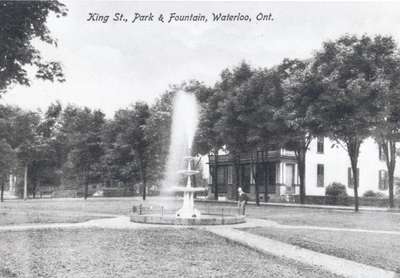
The other park, on the west side of King, is called Brewmeister Green. You can see the Terrace on the Square retirement home in the background. The main features of the park are a Glockenspiel (in the gazebo; it has been broken for many years) and a fountain.
Brewmeister Green used to be called Kuntz Brewery Park. The current fountain (built in 1950, but lost in the greenery for many years) is small and plain. Historically it was a larger fountain and was a popular place to cool off. Here are some photos of Kuntz Brewery Park from 1900-1925:
I think Brewmeister Green is used a little bit more than Heritage Green, and I imagine it's a nice resource for the people in the retirement home, even if it's only to look out the window. Both parks have some mature trees and lovely flower plantings.
A few years ago, a local group raised funds to erect a giant obelisk in Heritage Green. The obelisk was going to portray our history in carvings from the bottom to the top. I saw details of the plans and I (along with many others) thought the finished piece would be a terrible mistake. (Luckily City Council killed the idea.) The concrete in Heritage Green and the Glockenspiel/gazebo in Brewmeister Green seem like similar well-intentioned but dubious ideas.
These two identically sized parks, positioned at a major intersection in the uptown, provide a fantastic opportunity both aesthetically and to provide greenspace for uptown residents, workers and visitors. They also provide an opportunity to regain our heritage.
My suggestion for the parks is to decide on goals, which I propose as:
The other park, on the west side of King, is called Brewmeister Green. You can see the Terrace on the Square retirement home in the background. The main features of the park are a Glockenspiel (in the gazebo; it has been broken for many years) and a fountain.
Brewmeister Green used to be called Kuntz Brewery Park. The current fountain (built in 1950, but lost in the greenery for many years) is small and plain. Historically it was a larger fountain and was a popular place to cool off. Here are some photos of Kuntz Brewery Park from 1900-1925:
I think Brewmeister Green is used a little bit more than Heritage Green, and I imagine it's a nice resource for the people in the retirement home, even if it's only to look out the window. Both parks have some mature trees and lovely flower plantings.
A few years ago, a local group raised funds to erect a giant obelisk in Heritage Green. The obelisk was going to portray our history in carvings from the bottom to the top. I saw details of the plans and I (along with many others) thought the finished piece would be a terrible mistake. (Luckily City Council killed the idea.) The concrete in Heritage Green and the Glockenspiel/gazebo in Brewmeister Green seem like similar well-intentioned but dubious ideas.
These two identically sized parks, positioned at a major intersection in the uptown, provide a fantastic opportunity both aesthetically and to provide greenspace for uptown residents, workers and visitors. They also provide an opportunity to regain our heritage.
My suggestion for the parks is to decide on goals, which I propose as:
- Make the parks address the wants and needs of local residents and workers.
- Preserve existing trees.
- Regain heritage features and uses.
- Create an attractive harmonized look for the two parks.
- Watch the parks at various times of day to see how they're being used now (if they are).
- Survey local residents and workers to find out how they'd use the park. Would workers eat lunch there? Would residents use it? And so on.
- Do research to find more about the history of the parks.
- Ask all residents of Waterloo for opinions and designs.
- Hire a professional park architect to design the spaces.
Demand more for uptown
Development in Waterloo is booming. Four large high-rises are going up: 144 Park, 155 Caroline, a condo building in the Barrelyards (Erb and Father David Bauer Drive), and a rental building in the Barrelyards. Many projects are recent or almost finished, like 186/8 King South (The Red). Other large high-rises are in the planning stages, like 31 Alexandra Ave.
I have a nagging worry that the pace of development is so fast that there will be negative repercussions, but I am by nature a worrywart and I can't provide any foundation for those concerns.
My major concern is that the city is not being proactive enough to provide amenities to balance all these new residents.
All of the development to date is based on the cachet of the uptown. The small, pricey condos are aimed at well-off people without kids. Many of them are retirees who want to be able to walk to a coffee shop or a restaurant. Many of them are tech workers (like myself) who are seeking a vibrant urban environment.
The sad truth is that the uptown could be a lot more vibrant and a lot more interesting to live in. We have the Public Square, which is great, but let's face it, it's a small expanse of white concrete with a smattering of under-attended programming. Downtown Kitchener, for all its many problems, has always been more vibrant and interesting than uptown Waterloo, and has always had more interesting events.
Waterloo simply needs to up its game. There are so many things we could do:
Despite all the new development Waterloo is strapped, largely because of RIM Park debt and the unplanned costs of the LRT, so we need to be creative in funding. But we can't stop moving forward. The current attractiveness of the uptown is based on vision that was formulated in the 90s. The uptown badly needs visionary leadership that is rooted in the needs and wants of: uptown residents, uptown businesses and workers, and the residents of Waterloo for whom the uptown should be a central resource.
Over the next few posts I'll explore some of these ideas in more detail.
I have a nagging worry that the pace of development is so fast that there will be negative repercussions, but I am by nature a worrywart and I can't provide any foundation for those concerns.
My major concern is that the city is not being proactive enough to provide amenities to balance all these new residents.
All of the development to date is based on the cachet of the uptown. The small, pricey condos are aimed at well-off people without kids. Many of them are retirees who want to be able to walk to a coffee shop or a restaurant. Many of them are tech workers (like myself) who are seeking a vibrant urban environment.
The sad truth is that the uptown could be a lot more vibrant and a lot more interesting to live in. We have the Public Square, which is great, but let's face it, it's a small expanse of white concrete with a smattering of under-attended programming. Downtown Kitchener, for all its many problems, has always been more vibrant and interesting than uptown Waterloo, and has always had more interesting events.
Waterloo simply needs to up its game. There are so many things we could do:
- Revitalize King north of Erb with a new streetscape and better parking.
- Do something spectacular with the Post Office land at King and Bridgeport.
- Finish the two little parks on the east and west of King, on the south side of William.
- Revitalize the park east of City Hall (it had flower plantings until a few years ago, and now is just an abandoned area with a cenotaph).
- Finish the path that follows the railway tracks across Waterloo Square - and in general, connect the trails through the uptown.
- Beautify the exposed parts of Laurel Creek behind City Hall.
- Do something spectacular with the Pumping Station on William Street across from Regina.
- Fix and use the fountain in front of the Parkade at King and Willis Way
- Make better use of the east-side train station.
- Add amenities to the Public Square.
- Engage the public in programming the Public Square. For example, start a citizen's advisory committee to handle part of the programming.
- Get serious about making the uptown accessible to people with wheelchairs, walkers, and baby push-carts.
- Get serious - in a pragmatic, not ideological way - about traffic in the uptown.
- Develop an arts strategy that cuts loose the money-pit that is the Clay and Glass Gallery, and creates some serious artistic attractions in the uptown
Despite all the new development Waterloo is strapped, largely because of RIM Park debt and the unplanned costs of the LRT, so we need to be creative in funding. But we can't stop moving forward. The current attractiveness of the uptown is based on vision that was formulated in the 90s. The uptown badly needs visionary leadership that is rooted in the needs and wants of: uptown residents, uptown businesses and workers, and the residents of Waterloo for whom the uptown should be a central resource.
Over the next few posts I'll explore some of these ideas in more detail.
Sunday, August 04, 2013
Libertarians return to school
The Wall Street Journal published an article this week that, in line with its usual far-right stance, argued that a libertarian approach to education is far superior to the American system of hiring permanent, accredited teachers.
The article started with the premise, “South Korea's students rank among the best in the world, and its top teachers can make a fortune. Can the US learn from this academic superpower?” The article focused on one South Korean teacher who makes $4M per year, and quoted him as saying, “The harder I work, the more I make... I like that.” In describing this man’s work environment, the article says that 10% of the teachers are fired every year (compared to 2% of public school teachers in the US) and “the teachers are free agents. They don't need to be certified. They don't have benefits or even a guaranteed base salary.“
The monumental idiocy (or deceit) of the article is that it is comparing apples and oranges. South Korea has schools, but what the article is describing is after-school tutoring. The tutor being described creates online classes that are charged per view.
The US also has after-school tutors, and it has companies that seek to make big profits off of tutoring. The difference isn’t the availability of teachers or online courses. The difference is demand, and the real question is why parents in North America aren’t as driven to have their children excel at school. I don’t know about South Korea, but in many colonial countries access to education is competitive, which encourages higher performance but puts the emphasis on rote learning. This pattern exists across a variety of school environments.
In any event, the real problem facing the US is lack of access to post-secondary education. The article focuses on South Korea’s higher rate of high school completion, but a diploma is important mostly as a means of getting into college or university. Many US families know that they can’t afford higher education for their kids. Even where there is an affordable school, the affordable schools tend not to provide first rate training in subjects that lead to high-paid jobs. Government involvement in education should be just the opposite of the libertarian approach. Government should be setting goals for the graduation of doctors, engineers, computer science and the like, and finding ways to meet those goals.
Back in the 90s the center-left was changed by Bill Clinton, Tony Blair, Bob Rae, Jean Chretien and others to what was then called “the third way”. It became a tenet of progressivism that the economy must be healthy, and that progressive governments must be good economic stewards. The idea is to focus on the size of the pie and not just the size of the pieces.
More recently the right has transformed itself just as radically. Conservatism is increasingly becoming libertarian – and libertarianism is a crazy philosophy. Milton Friedman argued that there should be no requirements for calling yourself a medical doctor as the market would sort it out. I always thought of Friedman as a thorough Libertarian nutbar, but this disingenuous WSJ article is calling for the same thing for US public school teachers. It’s difficult for me to understand how these people could be so irrational, wrong-headed and irresponsible.
The article started with the premise, “South Korea's students rank among the best in the world, and its top teachers can make a fortune. Can the US learn from this academic superpower?” The article focused on one South Korean teacher who makes $4M per year, and quoted him as saying, “The harder I work, the more I make... I like that.” In describing this man’s work environment, the article says that 10% of the teachers are fired every year (compared to 2% of public school teachers in the US) and “the teachers are free agents. They don't need to be certified. They don't have benefits or even a guaranteed base salary.“
The monumental idiocy (or deceit) of the article is that it is comparing apples and oranges. South Korea has schools, but what the article is describing is after-school tutoring. The tutor being described creates online classes that are charged per view.
The US also has after-school tutors, and it has companies that seek to make big profits off of tutoring. The difference isn’t the availability of teachers or online courses. The difference is demand, and the real question is why parents in North America aren’t as driven to have their children excel at school. I don’t know about South Korea, but in many colonial countries access to education is competitive, which encourages higher performance but puts the emphasis on rote learning. This pattern exists across a variety of school environments.
In any event, the real problem facing the US is lack of access to post-secondary education. The article focuses on South Korea’s higher rate of high school completion, but a diploma is important mostly as a means of getting into college or university. Many US families know that they can’t afford higher education for their kids. Even where there is an affordable school, the affordable schools tend not to provide first rate training in subjects that lead to high-paid jobs. Government involvement in education should be just the opposite of the libertarian approach. Government should be setting goals for the graduation of doctors, engineers, computer science and the like, and finding ways to meet those goals.
Back in the 90s the center-left was changed by Bill Clinton, Tony Blair, Bob Rae, Jean Chretien and others to what was then called “the third way”. It became a tenet of progressivism that the economy must be healthy, and that progressive governments must be good economic stewards. The idea is to focus on the size of the pie and not just the size of the pieces.
More recently the right has transformed itself just as radically. Conservatism is increasingly becoming libertarian – and libertarianism is a crazy philosophy. Milton Friedman argued that there should be no requirements for calling yourself a medical doctor as the market would sort it out. I always thought of Friedman as a thorough Libertarian nutbar, but this disingenuous WSJ article is calling for the same thing for US public school teachers. It’s difficult for me to understand how these people could be so irrational, wrong-headed and irresponsible.
Wednesday, June 12, 2013
Uptown Waterloo: Where trails go to die
The Iron Horse Trail officially ends at Caroline Street. A few years ago, the Trails committee managed to get the trail unofficially extended along the west side of Caroline as far as William Street: the narrow sidewalk was replaced with a smooth, three meter wide asphalt trail. But even that bit of the trail lacks any signage. And at William it peters out altogether. If you know what you’re doing you can carry on down Caroline for two long blocks and cross Erb Street, where the trail starts again and goes into Waterloo Park. What we urgently need is to:
- Finish the part of the trail on Caroline, with trail signs and safe crossings.
- Create a trail from William to Erb along the west side of Caroline, with at least three meters width of smooth pavement, and with signs.
Subscribe to:
Posts (Atom)